• Home
  • Post

solobeatles

The website for the book Still the Greatest: The Essential Songs of the Beatles' Solo Careers

Menu

  • About the Book/ Get It Here!
  • About the Book/ Press & Reviews
  • About the Book/ Upcoming Events
  • About the Writer/ Contact
  • Additional Content on Facebook
  • Beatles Albums That Should Have Been
  • Book Excerpts
  • Breaking Beatle News
  • Corrections
  • Facebook
  • George
  • John
  • Links
  • News
  • Paul
  • Playlists
  • Rarities
  • Ringo
  • Sixties Beatles
  • Store
  • Uncategorized
  • Cool Websites

    • Beatle Links
    • Beatlefan Magazine Facebook Site
    • Beatles Blog
    • Beatles Rarity
    • BeatlesNews
    • Endless Rain
    • Fab Four FAQ 2.0 Facebook Site
    • FAB4RADIO.com
    • Fest for Beatles Fans
    • In the Life of … The Beatles

Lennon’s Only Non-Album B-Side: “Move Over Ms. L”

April 18, 2015 · by solobeatles

I didn’t cover this song in my book but here’s an article on it from the fantastic website www.beatlesbible.com:

The b-side to John Lennon’s Stand By Me single was first recorded during the sessions for the Walls And Bridges album.

Move Over Ms L was originally intended to appear on Walls And Bridges, but was left off at the last minute. It had been positioned between Surprise Surprise (Sweet Bird Of Paradox and What You Got on the album’s second side, but Lennon decided to remove it just before the pressing was due to begin, fewer than three weeks before its release.

Move Over Ms L was later re-recorded, and subsequently became the only non-album b-side of Lennon’s career, and was issued with the Stand By Me single, taken from the Rock ‘N’ Roll album, in early 1975.

The song vaguely poked fun at Lennon’s estranged wife Yoko Ono, although the playful lyrics were clearly not intended to hurt the woman who once referred to herself in song as Mrs Lennon.

Now to err is something human and forgiving so divine
I’ll forgive your trespasses if you forgive me mine
Life’s a deal, you knew it when you signed the dotted line
They nail you to the paper, put a rope around your neck
And so we sing along, the boy stood on the burning deck

Lennon recorded a home demo of Move Over Ms L prior to recording Walls And Bridges. He performed the song on an electric guitar, playing a boogie riff and singing the chorus in falsetto while his girlfriend May Pang made a phone call in the background.

A second demo was taped around a month later, in June 1974. A more serious attempt than the first, this was performed on an acoustic guitar. Lennon whispered the lyrics in an apparent attempt to not wake up Pang, and featured a quick improvised impression of Ono.

Lennon finally brought the song to the studio during the Walls And Bridges sessions. It was recorded in just three takes on 15 July 1974; one of the attempts was released on the 1998 box set John Lennon Anthology. This was more country and western in its feel, with a slide guitar solo by Jesse Ed Davis, but evidently failed to capture the sound Lennon was after.

The song was then given to Keith Moon, one of Lennon’s drinking buddies during the Lost Weekend. Moon recorded the song for his album Two Sides Of The Moon, and was released in April 1975. It was also the b-side of his single Solid Gold.

Lennon re-recorded Move Over Ms L in October 1974, and it became the only original composition of the Rock ‘N’ Roll sessions. This time Lennon was satisfied with the recording, and it was duly issued with the Stand By Me single.

Written by: Lennon
Recorded: 15 July 1974; 21-25 October 1974
Producer: John Lennon

Released: 18 April 1975 (UK), 10 March 1975 (US)

John Lennon: vocals, electric guitar
Jesse Ed Davis: electric guitar
Eddie Mottau: acoustic guitar
Klaus Voormann: bass guitar
Ken Ascher: piano
Bobby Keys, Steve Madaio, Howard Johnson, Ron Aprea, Frank Vicari: horns
Jim Keltner: drums
Arthur Jenkins: percussion

Available on:
John Lennon Signature Box
John Lennon Anthology
Ultimate Yacht Rock: McCartney’s “Girls’ School”

April 17, 2015 · by solobeatles

Wings’ rhythm guitarist Denny Laine lived on a houseboat, so he suggested making their next album (which would end up being called LONDON TOWN) on the water. So in May 1978, the group set up shop on the yacht Fair Carol in the Virgin Islands.

The band established a routine of a three- or four-hour session in the morning, followed by water skiing, swimming, and eating lunch cooked by the captain/chef. When they played, dolphins would swim around the boat digging the sound.

The song came about when McCartney was in Hawaii reading the back of the newspaper where they had the ads for the porno flicks. McCartney wrote down the titles—School Mistress, Curly Haired, Kid Sister, The Woman Trainer—and made up a song based on them. It was another creation in the Beatles tradition of “found art,” like when Lennon lifted all the words for “Being for the Benefit of Mr. Kite” from a vintage poster.

Lead guitarist Jimmy McCulloch loved rocking out in concert and was generally frustrated by the low-key songs of LONDON TOWN, but here he had a perfect vehicle to let it rip with Laine.

As was McCartney’s wont, he held prime cut “Girls’ School” off the album to serve as the rocking B-side to the softer A-side (in this case, “Mull of Kintyre”), a tradition going back to “Another Day”/“Oh Woman Oh Why.” Like that earlier B-side, this one sports a riff that seems strangely reminiscent of a tune on the album LED ZEPPELIN III, in this case, a simplified “Celebration Day.”

In the United Kingdom, the A-side “Mull” became the biggest non-charity single of all time, yet it flopped mysteriously in the United States. “Girls’ School” did better in the States, reaching number thirty-three. It would’ve been a great video to see them on the yacht rocking this one out to the dolphins.

“Café on the Left Bank” is another propulsive mid-tempo rocker from the sessions. The lyrics and McCulloch’s guitar work carry some of the cosmopolitan glamor of Duran Duran’s “Rio” and “Hungry Like the Wolf” four years early. It’s a travelogue sketch of hanging amidst Parisian crowds, dancing in the nightclubs, staggering back to your car and eating breakfast in the bars.

McCartney wanted to see what it would be like to record while the yacht was actually moving, which would have been a very Duran Duran moment, but unfortunately the motion flung Joe English into his drums and the concept was quickly abandoned.


The McCartney/Costello Demos

March 27, 2015 · by solobeatles

The mid-‘80s saw a dip in McCartney’s career after the triumph of his 1982 album Tug of War.  Pipes of Peace (1983) received lukewarm critical response, his feature Give My Regards to Broad Street (1984) was a box office flop, and Press (1986) saw a significant drop in sales compared to his earlier releases.  McCartney decided an overhaul was in order and reached out to Elvis Costello (born Declan MacManus).

Costello originally rose to fame as a member of the late ‘70s punk/New Wave movement due to his angry intellectual persona, but the sophistication of his snarky wordplay and torch song melodies made him a genre all to himself.  Also, like McCartney he had a musician father, a Liverpudlian mother — and he had joined the Beatles fan club at age 11.

On George Harrison’s recent comeback album Cloud Nine (1987), producer Jeff Lynne cajoled him to get back in touch with the Beatle qualities he had suppressed in order to prove he could make it on his own.  On Flowers in the Dirt, Costello did the same for McCartney, first by encouraging him to get his Hofner violin bass out of mothballs. Deciding the past was now far enough away, McCartney did so and from then on played it regularly.

McCartney relished working with Costello, whose cynical persona was reminiscent of Lennon’s. However, when Costello started answering back in song, as Lennon did in “Getting Better,” McCartney initially balked, fearing they were setting themselves up for too close a comparison.  Still, he eventually relaxed, and Costello joined the tradition of singing partners with whom McCartney competes for a girl in a song. Lennon did so in “You’re Gonna Lose That Girl,” Michael Jackson in “The Girl Is Mine,” and Costello in “You Want Her Too.”

In 1987 and 1988, McCartney and Costello recorded an album’s worth of acoustic demos. Twelve were eventually re-recorded for various albums or b-sides, but to many hardcore fans the demos are actually superior to the slickly produced official versions. The high-pitched harmonies of the “My Brave Face” demo have the strength and purity of the Fabs in 1963.

The “Don’t Be Careless Love” demo recalls the heyday of British duos like Chad and Jeremy and Peter and Gordon, but on Flowers in the Dirt, McCartney dropped Costello’s voice in the mix and swathed it with ‘80s production gauze.

He did the same for “That Day Is Done,” but at the Concert for Linda’s Memorial in 1999, Costello knocked it out of the park accompanied just by piano.

Hopefully, Macca and Costello will officially release the original demos one day soon.

Probably their finest collaboration was “Veronica,” which appeared on Costello’s 1989 album Spike. A shimmering up-tempo number, paradoxically it was about Costello’s grandmother who suffered from Alzheimer’s.  (“The Day is Done” was about her death.)  It was Costello’s biggest hit in the US, making it to No. 19 on Billboard and No. 1 on the Modern Rock chart.

Of the twelve McCartney-Costello songs that have so far seen official release, the only ones on which the two sing together are “My Brave Face,” “You Want Her Too,” and “Veronica.” The others include: the fine “Back on My Feet,” b-side to McCartney’s “Once Upon a Long Ago” (on bonus reissues of Flowers in the Dirt), “Don’t Be Careless Love” and “That Day Is Done” on Flowers in the Dirt, “Mistress and Maid” and “The Lovers That Never Were” on McCartney’s Off the Ground (1993), “Pads, Paws, and Claws” on Costello’s Spike (1989), “So Like Candy” and “Playboy to a Man” on Costello’s Mighty Like a Rose (1991), and “Shallow Grave” on Costello’s All This Useless Beauty (1996).

Vince Guaraldi and Marianne Faithfull cover “I’m a Loser”

March 25, 2015 · by solobeatles

Two interesting takes on Lennon’s 1964 classic. Guaraldi of course did the music for the Peanuts TV Specials, starring the world’s biggest loser, Charlie Brown, so this was a natural cover.

Solo Beatles discussion with Larry Rifkin Of WATR’s “Talk Of The Town”

March 2, 2015 · by solobeatles

Larry was kind enough to have me on last week to talk about the music of John, Paul, George, and Ringo after 1970. You can hear the conversation here. Thanks, Larry!

http://www.rifkinradio.com/?p=303

McCartney Gets “Back on His Feet” with the Help of Elvis Costello

February 23, 2015 · by solobeatles

http://www.youtube.com/watch?v=5cEzh1sjqGE

In the mid-’80s, the commercial drop off that had hit Starr and Harrison finally caught up to McCartney. First, his feature film GIVE MY REGARDS TO BROAD STREET (1984) was not well-received by the critics. For his follow up, 1986’s PRESS TO PLAY, he enlisted cutting edge producer Hugh Padgham (the Police, Phil Collins, Genesis, Peter Gabriel), but the record failed to go gold and was his worst-selling album to date.

As workaholic as ever, McCartney immediately started the next record with Billy Joel’s band and producer Phil Ramone, and they created an early version of “Back on My Feet.”

Ramone was dead center in the mainstream, but to spruce up the lyrics McCartney turned to New Wave singer-songwriter Elvis Costello. In their first meeting, they both brought unfinished songs for the other to fill in, like McCartney did with Lennon in the old days. Costello immediately helped bring “Back on My Feet” into sharp focus with concrete, vivid details.

In the first two verses, the protagonist is an old man railing at the thunderstorm pouring down on him, vowing to bounce back in the face of bruising setbacks. The defiance turns into cheerful optimism in the final verse, as a resilient young girl becomes the new protagonist, yelling that she’ll be back on her feet to the passing traffic. The characters ask us for a hand but warn us not to pity them, as they’ve seen things we’ll never see.

McCartney was still in a movie mindset and sings that the song is “in CinemaScope.” Each verse begins with cinematic terminology: “Reveal a,” “Cut to the,” “Focus in on,” “Cut back again to a . . .” At the end, McCartney sings that the song fades out as he pulls down the shade.

The amazing thing about McCartney is the number of times he’s rebounded from flops that would have discouraged someone with less fortitude: MAGICAL MYSTERY TOUR, WILD LIFE, BROAD STREET, Heather Mills. Perhaps the cost of producing so many successes was the inevitable dud, but the guy was a machine who never stopped.

“Back on My Feet” became a B-side that marked a moment of resurgence. The non album A-side “Once upon a Long Ago” featured an impressive orchestral lushness but also sappy lyrics about puppy dog tails, blowing balloons, and children searching for treasure, not to mention a Kenny G–like sax solo perfect for the corporate luncheon crowd. Costello arrived just in time to remind McCartney how not to be corny.

To Musician, Costello said, “There’s no denying that [McCartney] has a way of sort of defending himself by being charming and smiling and thumbs up and all the bit. I said once that I thought he should try and step from behind that, at least insofar as the music was concerned.”

Re-energized and refocused, with his next album (FLOWERS IN THE DIRT) and subsequent world tour, McCartney would indeed be back on his feet.

“Move Over Busker” was another fun track from the period that shared the movie imagery of “Back on My Feet,” along with its resolve to overcome the disappointment of GIVE MY REGARDS TO BROAD STREET.

http://www.youtube.com/watch?v=EIvthEC41Us

A pub rocker refitted with a modern sound, “Move Over Busker” was akin to a surreal Bob Dylan tune in the sense that McCartney meets a famous actor from the past in each of the three verses.

The first is Nell Gwynne, an actress and mistress of King Charles II in the 1600s. She started out selling oranges in the theater as cover for the fact that her real job was to be a liaison between the male patrons and the actresses backstage, who were also prostitutes. Hence, McCartney sings to her that he’ll have one of her oranges, but she tells him to “Move Over Busker.”

In the next verse he sees Mae West. Quoting her famous catch phrase, McCartney tells her he’ll come up and see her sometime, but she tells him to “Move Over Busker.”

It’s as if, in McCartney’s subconscious, after BROAD STREET’S failure he keeps getting rejected by actresses and is reduced to playing for change in the street.

Finally, in the bridge, he beats his chest and asserts that no one can hold him back and his time will come again. We see both the desperation and steely drive that kept him working for the chart hits. He sings that he wants to stay with the action, knowing if he doesn’t “grab it now,” his “great illusion” will vanish, before busting out with a Little Richard howl.

In the third verse, he’s nursing his injured pride when he sees a satisfied Errol Flynn being called into his trailer by a lusty lady. Flynn’s getting the love now, but McCartney tells him to move over, busker, because Flynn’s day is done and McCartney’s is on the way.

In the tradition of his ’70s albums, the refrain “good times coming” echoes another song on PRESS TO PLAY, “Good Times Coming/Feel the Sun.”

George Lightens Up in “Crackerbox Palace” with the Help of Monty Python

October 8, 2014 · by solobeatles

The titular palace was the home of legendary comedian Lord Buckley. His manager Mr. Grief (name checked in the lyrics) showed Harrison around the grounds and inspired the track, which is on 1976’s Thirty-Three and 1/3rd. After the darkness of Harrison’s previous two albums, the song captures him trying to grow up by embracing love and laughter, helped by his burgeoning friendship with British comedy troupe Monty Python.

Python’s Eric Idle directed the song’s video on Harrison’s own eccentric estate Friar Park, with Hari doing his version of Lennon’s goonish smiles and hand gestures from the “Another Girl” segment of Help!

http://www.eyeneer.com/video/rock/george-harrison/crackerbox-palace

George hand gesture 00:25

http://www.jukebo.com/the-beatles/music-clip,another-girl,uvrms.html

John hand gestures 1:57

Peter Asher Produces One of Ringo’s Deepest Cuts: “Golden Blunders”

October 8, 2014 · by solobeatles

A song about troubled marriage and inescapable guilt by alternative power pop band The Posies, producer Peter Asher heard it while driving cross country and thought it would be a great song for Starr to cover on his album Time Takes Time (1992).

At first Starr didn’t like it, recalled Posies guitarist Ken Stringfellow to Ready Steady Go! in 1994. “But then Ringo saw the lyrics written somewhere and he thought ‘Aw, wow, it’s a deep song!’ I mean “Golden Blunders” is a Beatles pun and then a Beatle does it! And you’ve just gotta love Ringo’s drums, he does that “Ticket to Ride” kind of thing!”

Before Asher was a producer, he was of course half of the pop duo Peter and Gordon. And when Paul McCartney lived with the family of Jane Asher in the mid-’60s, Peter and Paul lived right down the hall from each other, which was why Lennon-McCartney wrote four singles for Asher and partner Gordon Waller, including this gem:

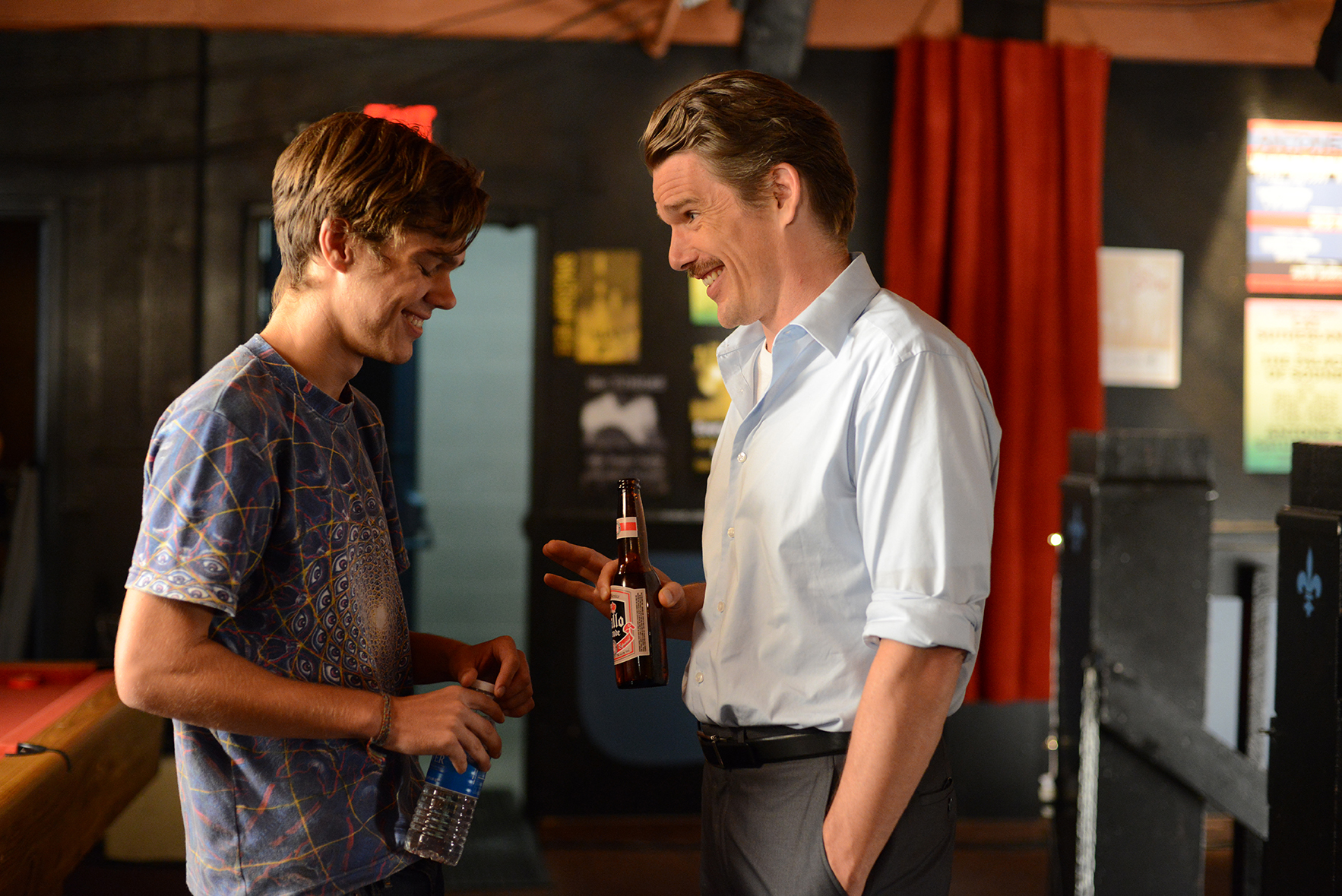
Ethan Hawke Makes Solo Beatles Compilation in BOYHOOD

October 8, 2014 · by solobeatles

Richard Linklater’s terrific film Boyhood has a great sequence where the father, Ethan Hawke, gives his son a mix of solo Beatles tracks. Buzzfeed printed Hawke’s playlist along with his heartfelt note about how coming to terms with the Beatles’ breakup echoed coming to terms with his own divorce. Thanks to Hawke and Linklater for reminding the world that the great Beatle music didn’t stop in 1970!

http://www.buzzfeed.com/ethanhawke/boyhood-the-black-album?bftw=main#3f36lx9

CREDIT: Matt Lankes for IFC Films

iTunes Releases Collection of Solo Beatles Tracks

October 8, 2014 · by solobeatles

For the first time, Apple and iTunes released a compilation of solo songs featuring cuts by all four Beatles last month. Perhaps they are running out of ways of repackaging the ’60s catalog and are testing the waters for a whole new era in (solo) Beatles collections, if all the estates can get on the same page regarding the licensing issues. Obviously, I think that would be fantastic, though personally I think they could have chosen stronger songs to make a splashier statement for this first effort. Still, it must be said that George’s “Let it Down” and Paul’s “Call Me Back Again” were pretty out-of-the-box choices, so you have to give them props for that. John’s “Love” is a near-standard, and Ringo’s “Walk With Me” is a reunion with Paul, so those are more obvious choices for what will hopefully become a new tradition. Here’s a recent article on the e.p.:

http://ultimateclassicrock.com/beatles-free-itunes/

John Paul George and Ringo

Page 5 of 11 « Previous 1 … 3 4 5 6 7 … 11 Next »
  • Create a free website or blog at WordPress.com.
Privacy & Cookies: This site uses cookies. By continuing to use this website, you agree to their use.
To find out more, including how to control cookies, see here: Cookie Policy
  • Subscribe Subscribed
    • solobeatles
    • Already have a WordPress.com account? Log in now.
    • solobeatles
    • Subscribe Subscribed
    • Sign up
    • Log in
    • Report this content
    • View site in Reader
    • Manage subscriptions
    • Collapse this bar
 

Loading Comments...