• Home
  • Post

solobeatles

The website for the book Still the Greatest: The Essential Songs of the Beatles' Solo Careers

Menu

  • About the Book/ Get It Here!
  • About the Book/ Press & Reviews
  • About the Book/ Upcoming Events
  • About the Writer/ Contact
  • Additional Content on Facebook
  • Beatles Albums That Should Have Been
  • Book Excerpts
  • Breaking Beatle News
  • Corrections
  • Facebook
  • George
  • John
  • Links
  • News
  • Paul
  • Playlists
  • Rarities
  • Ringo
  • Sixties Beatles
  • Store
  • Uncategorized
  • Cool Websites

    • Beatle Links
    • Beatlefan Magazine Facebook Site
    • Beatles Blog
    • Beatles Rarity
    • BeatlesNews
    • Endless Rain
    • Fab Four FAQ 2.0 Facebook Site
    • FAB4RADIO.com
    • Fest for Beatles Fans
    • In the Life of … The Beatles

Starr’s Surf Rock Ode to Alcoholic Jet Set Madness

June 2, 2015 · by solobeatles

http://www.youtube.com/watch?v=cB5FlVtCFZg

The dark climax of 2005’s Choose Love album, “Free Drinks” glamorizes Starr’s playboy/Arthur-like lifestyle even as the sinister music hints at disaster lurking just around the corner.

Most of Starr’s recent songs have been self-empowerment anthems with a modern retro sound, but one wishes Starr would offer more glimpses into his real existence like this one. (Though presumably the song recalls a period before he and his wife Barbara Bach got sober together.)  Boasting about his life of sunbathing by day, blackjack and roulette by night, it shares the specificity of rappers’ lyrics, who Courtney Love once famously compared to Bret Easton Ellis (American Psycho) for their slavish devotion to listing all brand names. While Starr doesn’t go that far, his snapshot of paintings by Chagall on the wall of his hotel suite with a dress on the floor says it all.

Starr’s voice calls out through a processor like a consciousness once removed through a steady imbibement of any and all intoxicants. Musically, it’s surf rock meets Ennio Morricone’s spaghetti western soundtracks. The reverb, delay, and tremolo also recall the Pulp Fiction soundtrack or a sped-up “Wicked Game” by Chris Isaac, while the persistent beat pounds like a guy on a rager with no end in sight. Laughing, Starr sounds as if he is unhinged on absinthe or cracking up in an old black and white film like The Lost Weekend or Reefer Madness.

Starr jets to Spain, hooks up in a disco, then loses the woman, but it doesn’t matter because there’s more everywhere. He shops in Juan Les Pins, Cannes, and Saint-Tropez, and invites girls to stay at his suite in Saint Paul’s Colombe D’or. In the final verse, he wakes up flying in first class, unsure where he is, but who cares? (Though part of him whispers he may be heading for a fall.)

Harrison Revives Dylan’s Unfinished “I Don’t Want to Do It”

June 2, 2015 · by solobeatles

This lost gem was written by Bob Dylan circa 1970 but never recorded by him.  Harrison laid down an acoustic demo during the All Things Must Pass sessions. Structurally, the song was pretty much in place then, but Harrison dropped it for fourteen years.

Out of nowhere, “I Don’t Want to Do It” was revived through the prodding of Dave Edmunds. Edmunds was a Welsh rocker who had solo hits, formed Rockpile with Nick Lowe, and produced the likes of the Flaming Groovies, Stray Cats, and Fabulous Thunderbirds. Edmunds was commissioned to put together the soundtrack of the ignominious Porky’s Revenge (1985), sequel to Porky’s (1982), which, along with Animal House (1978) instigated the ’80s wave of raunchy teen sex comedies. Edmunds did his own songs for the movie and also got others to contribute. Somehow it was decided to revive Dylan’s understated, melancholy composition for the occasion.

“I Don’t Want to Do It” has a unique place in Harrison’s oeuvre, with a sound different from any other period. It’s a little more rich, deep, and organic than Gone Troppo and without the pop sheen of 1987’s Cloud Nine. The piano matches the poignancy of the lyrics, accompanied by an organ, perhaps in honor of Dylan’s mid-sixties classics. Michael Schrieve’s drums give the song a faster-paced momentum than the song would have possessed had it been on All Things Must Pass, as it was recorded after the changes brought about by a younger generation of coked-up New Wavers with drum machines. As usual, Harrison does his own back-up vocal harmonies. It’s too bad this very appealing sound with Edmunds was a one-off.

Dylan’s lyrics are unusually generic and seem to be not quite finished, which could be why he never released it. It opens with the singer wishing he could have another day of youth, back when he knew what was true and all he had to do was play in the yard.  It was probably written in the late ’60s by Dylan when he was under pressure to resume touring, which would mean leaving his wife and young children, now playing in the yard themselves.  The singer takes his woman into his arms and reassures her he doesn’t want to make her cry by saying goodbye.  Ultimately Dylan decided not to leave his home and family for another half decade.  Harrison could certainly relate, as this was the only song he released in the five years between 1982’s Gone Troppo and 1987’s Cloud Nine, except for a few songs for the movie Shanghai Surprise (1986).  Harrison had married his wife Olivia in 1978 and had son Dhani the same year; he didn’t want to leave home either.

Around this period Harrison also recorded a version of Dylan’s Desire outtake “Abandoned Love,” which ended up on Dylan’s career retrospective Biograph. One of Dylan’s best, it’s exciting to hear Harrison perform such a deep-cut Dylan tune, though Harrison’s modern pop approach can’t match the rustic, fiddle-haunted soul of Dylan’s original.

The demo from the All Things Must Pass sessions:

Paul and George Help James Taylor on the Original “Carolina in My Mind”

June 1, 2015 · by solobeatles

After the Beatles signed James Taylor to their label Apple in 1968, McCartney played bass on the original “Carolina in my Mind” and Harrison sang back up. As Wikipedia elaborates below, the lyrics refer to Taylor recording his first album at Abbey Road while the Fab Four (“the holy host of others”) did the White Album. Taylor also sings of being on the dark side of the moon, which perhaps influenced another band that recorded at Abbey Road, Pink Floyd.

Also on Taylor’s first album was “Something in the Way She Moves,” which of course became the first line to one of Harrison’s biggest hits.

From Wikipedia:
The song references Taylor’s years growing up in North Carolina.[4] Taylor wrote it while overseas recording for The Beatles’ label Apple Records. He started writing the song at producer Peter Asher’s London flat on Marylebone High Street, resumed work on it while on holiday on the Mediterranean island of Formentera, and then completed it while stranded on the nearby island of Ibiza with a Swedish girl Karin he had just met.[2][5] The song reflects Taylor’s homesickness at the time,[6] as he was missing his family, his dog, and his state.[5]
Dark and silent late last night,
I think I might have heard the highway calling …
Geese in flight and dogs that bite
And signs that might be omens say I’m going, I’m going
I’m gone to Carolina in my mind.
The original recording of the song was done at London’s Trident Studios during the July to October 1968 period, and was produced by Asher.[7] The song’s lyric “holy host of others standing around me” makes reference to The Beatles, who were recording The White Album in the same studio where Taylor was recording his album.[4] Indeed, the recording of “Carolina in My Mind” featured a credited appearance by Paul McCartney on bass guitar and an uncredited one by George Harrison on backing vocals.[4] The other players were Freddie Redd on organ, Joel “Bishop” O’Brien on drums, and Mick Wayne providing a second guitar alongside Taylor’s.[7] Taylor and Asher also did backing vocals and Asher added a tambourine.[7] Richard Hewson arranged and conducted a string part;[7] an even more ambitious 30-piece orchestra part was recorded but not used.[4] The song itself earned critical praise, with Jon Landau’s April 1969 review for Rolling Stone calling it “beautiful” and one of the “two most deeply affecting cuts” on the album and praising McCartney’s bass playing as “extraordinary”.[8] Taylor biographer Timothy White calls the song “the album’s quiet masterpiece.”[4]
The song was first released on Taylor’s eponymous debut album in December 1968 (February 1969 in the United States), and was later released as a single in the UK in February 1969 and in the US in March 1969.[9] However, owing to the same problems which plagued the release of the album (namely, Taylor’s inability to promote it due to his hospitalization for drug addiction), the single’s original release only reached number 118 on US pop charts and failed to chart in the UK.[9] Indeed, Taylor had fallen back into addiction during the London recording sessions,[4][10] and his line about being surrounded by Beatles had been immediately followed by Still I’m on the dark side of the moon.[6]
COMPLETE ARTICLE CAN BE FOUND AT
http://en.wikipedia.org/wiki/Carolina_in_my_mind


On a sadder note, below is an article about how Lennon’s New York neighbor James Taylor had an unnerving encounter with Mark David Chapman the day before Lennon was killed.

http://www.aolnews.com/2010/12/08/james-taylor-recalls-encounter-with-lennons-assassin/


(The photo on our home page with Lennon, Taylor, Yoko Ono, and Carly Simon was taken in 1977.)

The cartoon Beatles do Tomorrow Never Knows

May 19, 2015 · by solobeatles

You might have thought the animators for the Beatles’ Saturday morning cartoon would have been at a loss for how to build an episode around Lennon’s lysergic ode to The Tibetan Book of the Dead, but you’d be wrong …

They Should’ve Done This Instead of Magical Mystery Tour

May 16, 2015 · by solobeatles

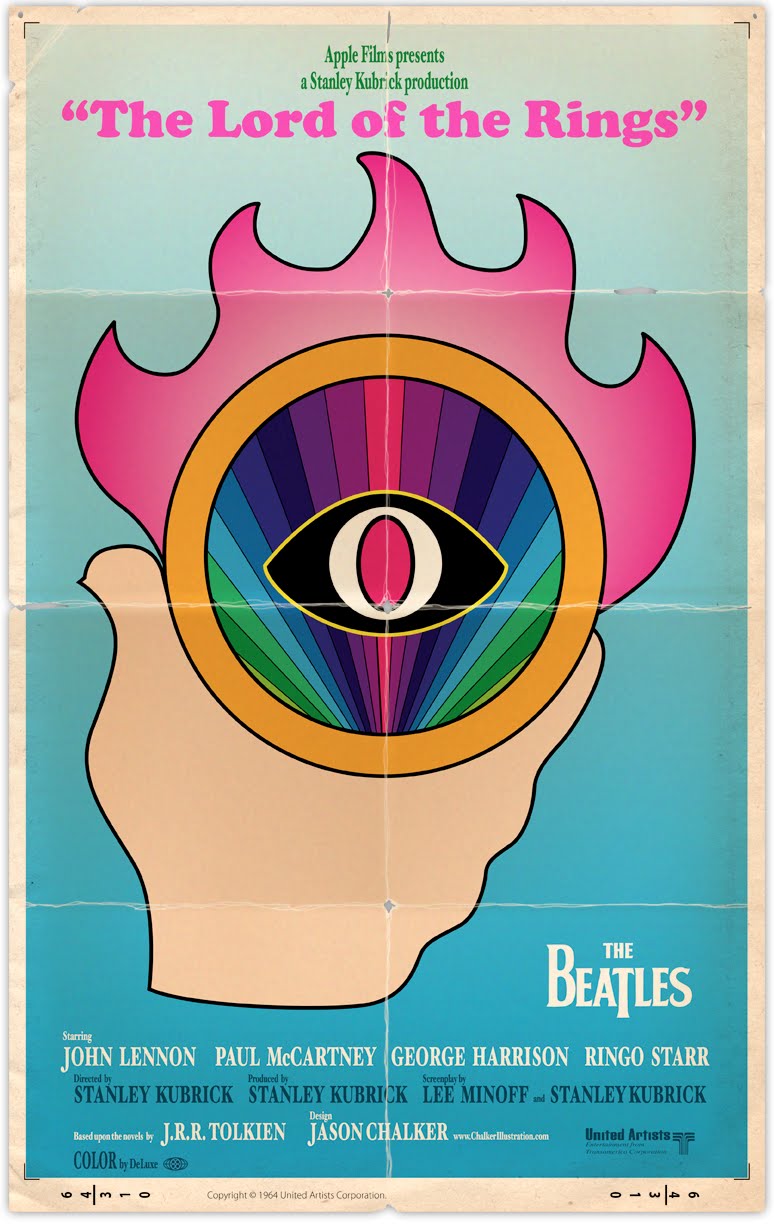
In 1967, the Beatles discussed starring in LORD OF THE RINGS. John wanted to play Gollum, mystic George was going to be Gandalf, Paul would be Frodo and Ringo would be Sam. To direct it, John contacted Stanley Kubrick (A Clockwork Orange, Dr. Strangelove, 2001). Tolkien himself nixed the idea, since he controlled the film rights, but it is fun to imagine what the film would have been like. The Beatles were notoriously impatient during film shoots, so doing a film with the slow-moving, meticulous Kubrick would have been one of the most fantastic films of the decade or a totally insane train wreck.BeatlesLotR

George’s Original Version of “It Don’t Come Easy”

May 11, 2015 · by solobeatles

Harrison had a habit of offering his best tunes to his friends. He originally gave “My Sweet Lord” to Billy Preston. He gave a song called “You Gotta Pay Your Dues” to Badfinger, although they turned it down.

So Starr took a crack at “You Gotta Pay Your Dues” during his Sentimental Journey sessions. George Martin produced and Stephen Stills was on the piano, but after thirty takes on February 18 and 19, 1970, it still wasn’t coming easy.

Thus Harrison sang a demo himself with Badfinger on backing vocals, instructing them to chant “Hare Krishna!” during the instrumental. In the final version of the song you can still hear it, low in the mix.

Starr tackled the song again on March 8, this time with Harrison producing. It sat in the can until October, at which point Harrison added sax and trumpet like he had once added horns to The White Album’s “Savoy Truffle.”

In mid-April 1971, Harrison’s haunting guitar intro finally drifted across the airwaves. Its arresting sound came courtesy of the Leslie speaker cabinet.

The cabinet was originally built for the Hammond organ but had been adapted for guitar and vocals. It housed a rotating bass speaker and a pair of horn speakers that spun around in different directions, making the guitar sound as if it was swirling under the ocean. Lennon ran his vocals through the Leslie for 1966’s “Tomorrow Never Knows,” and Harrison had used it in 1969 when he wrote “Badge” with Clapton for Cream; in fact, the “Badge” instrumental break sounds pretty close to “It Don’t Come Easy.” Harrison was always a master at recycling—or should we say, developing further. Thus the outro of “A Hard Day’s Night” became the intro to “Ticket to Ride.”

The Leslie effect became one of the most distinctive sounds of the late ’60s and early ’70s, gracing songs including Harrison’s “Something,” Badfinger’s “No Matter What,” the Grateful Dead’s “Casey Jones,” Three Dog Night’s “Mama Told Me Not to Come,” The Hollies’ “Air That I Breathe,” the Eagles’ “Hotel California,” Boston’s “More Than a Feeling,” and even McCartney’s “Listen To What the Man Said.”

Badfinger’s soaring backing vocals, Stills’s pounding piano, Starr’s perfect drum fills, and the horns build an epic momentum behind Starr’s exhortation to stay resilient in the face of hardship. The lines about paying dues to pay the blues probably wouldn’t have worked with Harrison singing; the guy came from a stable family and was a superstar before he was twenty. But Starr was born into an inner city house without a toilet, fell into a coma from appendicitis at age six, then was confined to a sanatorium for two years at age thirteen due to tuberculosis, before dropping out of school altogether.

In Beatles tradition, the lyrics challenged the listener to be peaceful. It was a sentiment that could apply on any scale, though it might have been aimed at McCartney, who was taking the others to court at the time. Yet with a reunion increasingly unlikely, the song actualized Harrison’s and Starr’s determination to carve out a career for themselves independent of the Lennon and McCartney gravy train.

Starr preaches with such confidence that you wouldn’t know he was filled with doubt about the direction of his life. Perhaps his determination to transcend his fears is what fills the performance with its enduring power.

Forty years later, Starr still opens every show with it. The song shot up the charts, passing Lennon’s “Power to the People,” Harrison’s “What Is Life” (both reached number eleven), and McCartney’s “Another Day” (number five), all the way up to number four, settling just beneath the Rolling Stones’ “Brown Sugar” at number one. It was the first of three top ten hits Harrison cowrote or produced for Starr. The success stunned those who had assumed Starr couldn’t cut it on his own.

(Compare “Badge” at 1:09 to “It Don’t Come Easy” intro)

(There it is again in “You Never Give Me Your Money” at 3:37)

Macca Gets Freaky With “Monkberry Moon Delight”

May 10, 2015 · by solobeatles

Backed by what sounds like a villainous circus organ from a creepy 1930s cartoon, McCartney lurches in with a voice that has gone beyond Little Richard into demented Screamin’ Jay Hawkins territory. In Hawkins’s seminal hit “I Put a Spell on You” (1956), he shrieked, gargled, cackled, and guffawed like an unhinged black Vincent Price. Onstage he would rise from a coffin bearing voodoo props. Later, Tom Waits would take up his growling, guttural mantle.

In his incendiary 1970 Rolling Stone interview, Lennon expressed surprise at McCartney’s self-titled first solo album, saying he expected more from him. At the dawn of 1971, McCartney found himself in the position of being dismissed by the critics while Lennon and Harrison were heaped with praise for their LPs Plastic Ono Band and All Things Must Pass. Pelted with tomatoes in his mind, he realized he must catch up with his second album Ram or be left behind.

He goes to the piano in the attic while the wild wind howls. He’s getting older, his hair’s a mess, he’s in his pajamas, his stomach is in knots from the bad reviews, and the rats are in the walls (both real farm rats and the ex-bandmates in his mind).

But then he sees Linda giving the kids their milk and it inspires him to get back in touch with his own absurd inner child. “When my kids were young they used to call milk ‘monk’ for whatever reason that kids do—I think it’s magical the way that kids can develop better names for things than the real ones. In fact as a joke, Linda and I still occasionally refer to an object by that child-language name. So, monk was always milk, and monkberry moon delight was a fantasy drink, rather like ‘Love Potion No. 9,’ hence the line in the song ‘sipping monkberry moon delight.’ It was a fantasy milk shake.”

Linda echoes his words like a gum-smacking, seen-it-all, hand-on-her-hip New York moll. Her singing gilds the razor’s edge of flatness with surprising defiance, as coached meticulously by her perfectionist husband. Finally, he degenerates into eerie howling and spastic mumbling.

Hawkins would go on to release “Monkberry Moon Delight” as a single in 1973.

Starr Recaptures the ’60s Sound with ’80s Disciples

May 10, 2015 · by solobeatles

http://www.youtube.com/watch?v=v6dKiS5e-QM

A jewel that could have come off of Help! or Rubber Soul, “I Don’t Believe You” was a track on one of Ringo’s best albums, Time Takes Time (1992). It was written by two members of the San Francisco power pop band Jellyfish, Andy Sturmer and Roger Manning, who also added backing vocals and acoustic guitars.

Another guy in Jellyfish, Jason Faulkner, had been in The Three O’clock, which was part of a short-lived Los Angeles movement called The Paisley Underground. That scene was comprised of groups in the ‘80s who were trying to sound like the ’60s in opposition to the synthesizers and drum machines that were then dominating the pop charts. The Bangles were the biggest Paisley Underground group to make it, epitomizing the genre with their 1985 single “Going Down to Liverpool.”

When the Ringed One speak-sings his lines as the backing singers answer him in harmony, the song is a perfect homage to the Beatles circa “You’re Gonna Lose That Girl” or “Run For Your Life” … not to mention Beatle-imitators like the Monkees or Knickerbockers.

Many mid-‘60s garage nuggets (such as Syndicate of Sound’s “Little Girl”) feature an agitated singer warning his woman that he knows she’s done him wrong and he’s at the end of his rope. Starr’s girlfriend has lied to him and maxed out his credit cards to buy fancy clothes and “powder for her nose.” So he’s kissing her goodbye for good, just in time for the rollicking instrumental with cries of “Ole! Ole!”

In the early ‘60s, McCartney wrote a number of these “disillusioned-with-my-woman” tunes, too, including one for Starr called “If You’ve Got Troubles” that went unreleased until being included on volume one of the Beatles Anthology. Oasis must’ve heard it earlier on a bootleg because they pilfered the riff for 1994’s “Up in the Sky.”

Credit for the album’s sound also goes to producer Don Was. Born Don Fagenson in Detroit in 1952, he was one of the founding members of Was (Not Was). The band had hits in the ‘80s, then Was racked up a stunning producer’s resume, doing albums or songs for Bob Dylan, Al Green, Garth Brooks, Iggy Pop, George Clinton, Paul Westerberg, and helping Bonnie Raitt win the 1990 Grammy Album of the Year for Nick of Time. He was also the producer the Stones picked to help them remaster Exile on Main Street in 2010 and find overlooked gems that could be refurbished for the Exile bonus album.

It’s a pity Time Takes Time is the only album Starr did with Was, but Starr continued to mine the ‘60s folk rock sound on his subsequent albums with producer Mark Hudson.

Ringo’s Movie Career

May 2, 2015 · by solobeatles

In the early ‘70s Ringo was wondering what he was going to do with the rest of his life.  He drummed on Lennon and Harrison’s albums, but that wasn’t enough.  He started a furniture company and designed things like donut-shaped fireplaces and flower-shaped tables with petal seats.   But mainly, he wanted to be an actor.

Back in ’64 he showed up on the set of A Hard Day’s Night terribly hung over to shoot the part of the movie that featured him alone, and his doleful countenance was praised as pristine naturalism. Thus the Beatles built their next movie, Help!, around Starr.  Indeed, while original drummer Pete Best may have been broodingly handsome (too handsome as far as McCartney and Lennon were concerned), Starr’s distinct look and persona were essential to the loveable moptop image that was so easily translated into cartoons and lunchboxes.  (Most anything that reaches global proportions has to be able to be translated into cartoons and lunchboxes.)

Lennon was the first Beatle to try his hand at acting in a movie apart from the others (in How I Won the War, which I still have not been able to bring myself to sit through).  But in 1968, after briefly quitting during The White Album sessions, Ringo started his own career.

He could’ve used an astute manager to help him select projects, however. Most of Starr’s films stand as cautionary artifacts of late ‘60s drug-addled indulgence. There were two disappointing Terry Southern adaptations  – Candy (1968) and The Magic Christian (1969) with Peter Sellers — Frank Zappa’s 200 Motels (1971), an Italian spaghetti Western Blindman (1971), and probably the best of them, Harry Nilsson’s animated TV special The Point! (1971). In 1972, Starr directed a rockumentary about his good friend Marc Bolan of T. Rex called Born to Boogie.

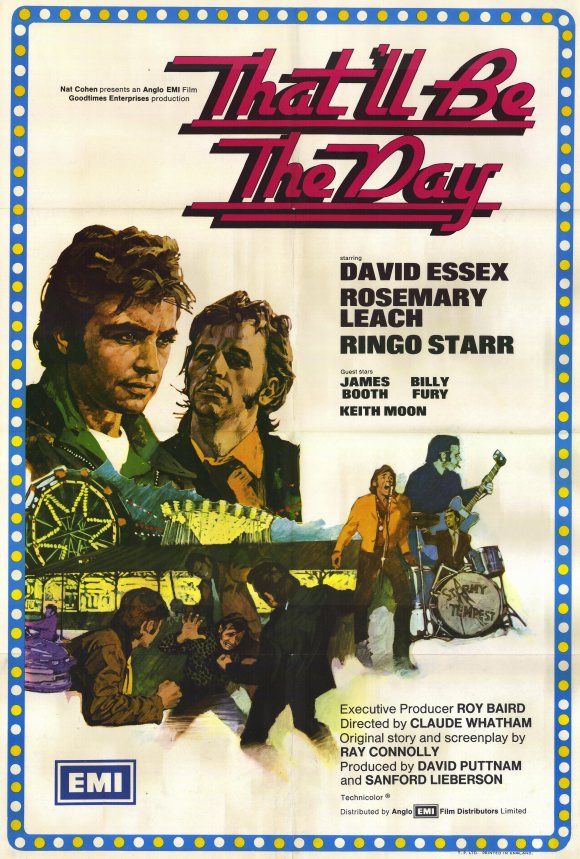
The film that could have been a turning point was That’ll Be the Day (1973), which captured the nostalgia craze in Britain like American Graffiti did here in the States, though it didn’t make much of a splash on American shores. Written by journalist Ray Connolly, it was inspired partly by the story of John Lennon’s rise.  Another influence was Harry Nilsson’s autobiographical song “1941,” about a father abandoning his son, which was one of the first things that drew Lennon to Nilsson, as it mirrored the story of his own childhood.  The movie took place in the late 1950s and featured singer David Essex (“Rock On”) as a young man working at a summer resort.  The streetwise Starr takes him under his wing, and eventually Essex’s character becomes a rock star.

Starr’s role was supporting but large. He played a Teddy boy, English cousins to American greasers, who wore velvet-collared jackets instead of the leather variety.  Starr had been in teddy boy gangs in his youth as a drop out, forced to participate in gang rumbles before finding a way out through music.

http://www.youtube.com/watch?v=5hQDzV9kkGo

http://www.youtube.com/watch?v=sPmHm29QktY&feature=related

Starr brought the same naturalistic, low-key charm to the role he had brought to A Hard Day’s Night. After the flops of his first two genre albums, Starr focussed on films and finally made an undeniably good movie. Had he continued performing in well-written indie films, he could’ve really made it as an actor. But just then, his record career kicked back in with the smash solo album Ringo, produced by Ringo’s best pal Nilsson’s producer Richard Perry.

A sequel was made to That’ll Be the Day called Stardust, in which Essex’ and Starr’s characters go through the decadent, psychedelic sixties. Perhaps because he was enjoying a streak of hit singles, Starr demurred and let buddy Keith Moon replace him in the role.

Starr and Nilsson attempted to do their own horror spoof called Son of Dracula (1974) but it was reportedly so bad Starr could subsequently not bear to look at it.  He also appeared as the Pope in Ken Russell’s follow up to Tommy, Lisztomania (1975), with Roger Daltrey as classical composer Franz Liszt.  But after That’ll be The Day, Starr’s most notable film was, alas, 1981’s goofy comedy Caveman.  He also appeared in McCartney’s meandering Give My Regards to Broad Street, which offered to pleasure of seeing half the Beatles hanging together and playing good music, but little by way of story.

After a string of albums throughout the ‘70s and early ‘80s, Starr’s declining sales brought his recording career to a halt.  Starr’s Old Wave (1983), produced by ex-Eagle Joe Walsh, contained some great tunes, but no label was interested in putting the record out in the U.S. or U.K. It would be his last album for nine years.  For the rest of the decade he only appeared in the aforementioned Broad Street, Little Steven’s Artists United Against Apartheid’s “Sun City” (with his son Zak Starkey), and a Grammy-nominated cover of “Act Naturally” with Buck Owens.

Giving up on finding a new record label, in 1984 he took the Thomas the Tank Engine and Friends narration gig.  Based on a series of children’s books, the TV show became a success in the U.K. and then around the world.  Starr narrated two seasons, and when it spun off an American PBS series called Shining Time Station he played Mr. Conductor, for which he was nominated for a Daytime Emmy in 1989.   “John had the intellectuals; Paul had the teenies and George the mystics; I always got the mothers and babies,” he quipped.   It was nice timing in that he was the first Beatle to become a grandfather, when Zak had a daughter named Tatia Jayne Starkey in 1985.

In 1989 he would form the Ringo Starr All-Star Band, resume touring, and go on to make some of his finest albums.  Still, one wonders what he could have done had he taken on more roles like That’ll Be the Day.

The Road to All Things Must Pass

April 26, 2015 · by solobeatles

The triple album All Things Must Pass was the culmination of a remarkable recipe of influences George Harrison had been synthesizing for years — Indian music, gospel and soul, slide guitar — matched with a new found commitment to more accessible vocals and hit songwriting, all set against producer Phil Spector’s epic backdrop.

In the mid-‘60s Harrison took time out from the guitar and focused on the sitar while Clapton, Hendrix, Beck, Page and others competed to be the most technically impressive. As Simon Leng points out in his excellent book While My Guitar Gently Weeps: The Music of George Harrison, Harrison had been the bridge between ‘50s rock guitarists like Carl Perkins and Elvis’ Scotty Moore and the ‘60s guitar virtuosos, but he didn’t relate to his contemporaries’ showboating.

Then, in late 1968, he visited with Dylan and the Band during the latter’s recording of Music For Big Pink (with tunes such as “The Weight”), and found kindred spirits ushering in a new, more restrained era where the musicians once again served the song itself as opposed to using it as a backdrop for instrumental pyrotechnics.

Dylan and the Band respected Harrison as an equal, so when Harrison returned to London for the January 1969 Get Back sessions, he could no longer endure the condescending treatment he received from Lennon and McCartney, who viewed him as their little brother. He briefly quit, then recalled how much better the guys had behaved when Eric Clapton came into the studio to play on “While My Guitar Gently Weeps” the year before. He hit upon the idea of bringing his friend keyboardist Billy Preston to flesh out the group’s sound, since the climax of the Get Back sessions was going to be a concert on the roof of Apple Records. With Preston in tow, Harrison returned to the group.

Later that year he would produce an album for Preston and also one for Doris Troy (whose hits included “Just One Look”), both soul albums with heavy gospel influence. Working with the Edwin Hawkin Singers gospel choir (whose songs included the classic hit “Oh Happy Day”), he found the black American equivalent of the spirituality he felt in Indian music.  During this time Preston recorded Harrison’s song “My Sweet Lord,” but it went unnoticed.

Harrison then saw first hand how black music could be translated by Southern whites when he met husband-and-wife team Delaney and Bonnie Bramlett, who mixed soul, gospel, rock, blues, and country in a traveling revue called Delaney & Bonnie and Friends. The friends included no less than Clapton, Duane Allman, Leon Russell, Rita Coolidge, Dave Mason, King Curtis, and the guy who would go on to drum with the solo Beatles more than anybody, Jim Keltner. The revue was also how other future regulars Bobby Keys, Jim Price, and Jim Gordon came into the solo Beatles’ orbit. When Harrison saw Delaney and Bonnie in concert on December 1, 1969, he yearned for the entourages’ carefree camaraderie and asked if he could join their tour.

On the road, Harrison asked Delaney how to write gospel songs, and their improvised jam session became the genesis for “My Sweet Lord.” Delaney also mentored Harrison in the slide guitar. Harrison unveiled his new bottleneck technique in an early take of “If Not For You” on Dylan’s album New Morning (1971). Dylan ultimately did not use that take, but Harrison would do his own version of the song on All Things Must Pass (and could be heard on New Morning’s “Day of the Locust.”)

Harrison’s new guitar style, coming as it did at the dawn of his new era as solo artist, was like a superhero giving himself a new costume. He incorporated techniques learned from his apprenticeship in Indian instruments and fused them with slide techniques developed under Delaney’s tutelage, emerging with one of the most distinctive sounds of the early ‘70s, heard on his own songs, Lennon’s, Starr’s, and Beatle protégée Badfinger’s. It was similar to the way Keith Richards crystallized his own unique sound in the late ‘60s with the secret recipe of open tunings and no sixth string.

Along the way Harrison had also transformed his songwriting. When he had stalked out of the Get Back sessions, his songs were not the kind to burn up the hit parade (“For You Blue,” ”Old Brown Shoe,” and “I, Me, Mine”).  But if he was going to tell McCartney and Ono to shove it and still keep his forty-acre estate, he’d have to start writing hits.  Amazingly, he knocked two out of the park: “Here Comes the Sun” and “Something.” The latter became Harrison’s first number one hit and Sinatra proclaimed it the greatest love song of the twentieth century.  Harrison had penned the highlights of the last Beatle album just before the group disintegrated, the ultimate graduation from the Lennon-McCartney songwriting school of osmosis.

Harrison worked on his voice, too. Whereas he once sung with the surliest, thickest Liverpool accent of the bunch, now he lightened it up a notch, as he did with his melodies, fashioning them more warm and upbeat. As with his songwriting, he drew on what he learned vocally from the others, having been the “invisible voice” in the harmonies for ten years.

The Beatles’ producer George Martin never saw Harrison as an equal to Lennon and McCartney, so when Harrison branched out on his own he sought a new partner.  Phil Spector was the maestro behind a string of classic girl group and Righteous Brothers singles in the early 1960s that– in Lennon’s words – kept rock alive between the time Elvis went into the army and the year the Beatles arrived. A tiny man with a Napoleon complex, Spector created  “little symphonies for the kids” via huge orchestras and innovative recording techniques.

Lennon and McCartney both released debut solo albums that were as minimalist as possible – Lennon’s featured just him, Ringo, and Klaus Voormann on bass, while McCartney played everything on his himself.  Harrison, in contrast, brought in Delaney and Bonnie’s sizable backing group and a dozen other musicians.  Harrison was determined not to be like McCartney had been to him and dictate how his friends should play — instead, Harrison allowed the musicians to contribute what they wanted. They would all remember the happy atmosphere of All Things Must Pass.

The explosive bombast of Spector’s production made the album stand out from his ex-bandmates, just as his Indian epics stood apart from the others on the mid-60s Beatles albums. The Spector Wall of Sound was the perfect backdrop for a musician who had been ignored and was now determined to make as big a splash as possible. (Though Harrison would later regret using so much echo.)  Harrison’s euphoria at his freedom was palpable in each cut, and the timing for his religious theme was impeccable.

The end of the ‘60s saw a huge spiritual revival, as people looked for answers in the midst of a massive social upheaval (civil rights movement, anti-war movement, feminist movement, gay rights movement, Sexual Revolution, drug revolution). While many explored Eastern religions, Christianity also saw a huge resurgence, Lennon’s comment that it would “shrink and vanish” notwithstanding. “Jesus Freaks” bridged the gap between hippies and Christians, and the airwaves swelled with Biblical imagery. Songs with Gospel themes included The Byrds’ “Jesus Is Just All Right,” the Youngblood’s “Get Together,” Norman Greenbaum’s “Spirit in the Sky,” Simon and Garfunkel’s “Bridge Over Troubled Water,” and Ocean’s “Put Your Hand in the Hand.” Harrison rode the wave higher than any of them with “My Sweet Lord,” the best selling record of 1971. After its release, two smash hit musicals in a similar vein would open in New York, Jesus Christ Superstar and Godspell.

All Things Must Pass was three discs of much-needed light that countered the depressed darkness of the other Beatles’ debuts, and was the most sprawling high-profile release until Guns N Roses’ Use Your Illusion quadruple album 20 years later.  Harrison referred to the set as recovering from an “an eight-year dose of constipation,” an appropriate description for the first triple album by a mainstream artist. Many of the songs had been composed over the previous four years but rejected by Lennon and McCartney for inclusion on Beatles albums. In 1966 Harrison got three songs on Revolver (his peak in per-album composition count), but “Art of Dying” and “Isn’t It a Pity” were rejected. It was at this time that Harrison started stockpiling tunes, though many of the most accessible tunes on All Things Must Pass seem to have been composed after Harrison had his “Something”/”Here Comes the Sun” commercial breakthrough: “My Sweet Lord,” “What Is Life,” “Awaiting on You All,” and “The Ballad of Frankie Crisp.”

As George Martin said about The White Album, it would have been advisable for Harrison to carve All Things Must Pass down to one stupendous release and dole out the best of the rest over the next year or two. As it was, his next studio release wouldn’t come until 1973. With the third album comprised of long studio jams with Eric Clapton and friends, Harrison did seem to be pushing the limits of what a Beatle could get away with. Yet despite a hefty price tag, the album sat at No. 1 for seven weeks in the US and eight in the UK.

It would take Harrison 18 years to come close to revisiting that level of success. In 1970 and 1971, however, it seemed that the younger brother had left his older siblings in the dust.

Had Harrison pared it down to one stellar record, it could have been an undisputed masterpiece. And the two primary moods of the album could each rest nicely on either side of the album: the epic Spector orchestrations on side one, with the country/folk sound influenced by Dylan, the Band, and Nashville guitar player Pete Drake on side two.

Side One

  1. My Sweet Lord
  2. What Is Life
  3. Awaiting on You All
  4. Wah-Wah
  5. Hear Me Lord
  6. Run of the Mill
  7. Isn’t It A Pity

Side Two

  1. I’d Have You Anytime (co-written by Dylan)
  2. If Not For You (Dylan)
  3. Behind That Locked Door
  4. I Live For You (belatedly released on the 2000 remastered version)
  5. Apple Scruffs
  6. Ballad of Sir Frankie Crisp
  7. All Things Must Pass
Page 4 of 11 « Previous 1 2 3 4 5 6 … 11 Next »
  • Blog at WordPress.com.
Privacy & Cookies: This site uses cookies. By continuing to use this website, you agree to their use.
To find out more, including how to control cookies, see here: Cookie Policy
  • Subscribe Subscribed
    • solobeatles
    • Already have a WordPress.com account? Log in now.
    • solobeatles
    • Subscribe Subscribed
    • Sign up
    • Log in
    • Report this content
    • View site in Reader
    • Manage subscriptions
    • Collapse this bar
 

Loading Comments...