• Home
  • Post

solobeatles

The website for the book Still the Greatest: The Essential Songs of the Beatles' Solo Careers

Menu

  • About the Book/ Get It Here!
  • About the Book/ Press & Reviews
  • About the Book/ Upcoming Events
  • About the Writer/ Contact
  • Additional Content on Facebook
  • Beatles Albums That Should Have Been
  • Book Excerpts
  • Breaking Beatle News
  • Corrections
  • Facebook
  • George
  • John
  • Links
  • News
  • Paul
  • Playlists
  • Rarities
  • Ringo
  • Sixties Beatles
  • Store
  • Uncategorized
  • Cool Websites

    • Beatle Links
    • Beatlefan Magazine Facebook Site
    • Beatles Blog
    • Beatles Rarity
    • BeatlesNews
    • Endless Rain
    • Fab Four FAQ 2.0 Facebook Site
    • FAB4RADIO.com
    • Fest for Beatles Fans
    • In the Life of … The Beatles

Posts By solobeatles

Macca Gets Freaky With “Monkberry Moon Delight”

May 10, 2015 · by solobeatles

Backed by what sounds like a villainous circus organ from a creepy 1930s cartoon, McCartney lurches in with a voice that has gone beyond Little Richard into demented Screamin’ Jay Hawkins territory. In Hawkins’s seminal hit “I Put a Spell on You” (1956), he shrieked, gargled, cackled, and guffawed like an unhinged black Vincent Price. Onstage he would rise from a coffin bearing voodoo props. Later, Tom Waits would take up his growling, guttural mantle.

In his incendiary 1970 Rolling Stone interview, Lennon expressed surprise at McCartney’s self-titled first solo album, saying he expected more from him. At the dawn of 1971, McCartney found himself in the position of being dismissed by the critics while Lennon and Harrison were heaped with praise for their LPs Plastic Ono Band and All Things Must Pass. Pelted with tomatoes in his mind, he realized he must catch up with his second album Ram or be left behind.

He goes to the piano in the attic while the wild wind howls. He’s getting older, his hair’s a mess, he’s in his pajamas, his stomach is in knots from the bad reviews, and the rats are in the walls (both real farm rats and the ex-bandmates in his mind).

But then he sees Linda giving the kids their milk and it inspires him to get back in touch with his own absurd inner child. “When my kids were young they used to call milk ‘monk’ for whatever reason that kids do—I think it’s magical the way that kids can develop better names for things than the real ones. In fact as a joke, Linda and I still occasionally refer to an object by that child-language name. So, monk was always milk, and monkberry moon delight was a fantasy drink, rather like ‘Love Potion No. 9,’ hence the line in the song ‘sipping monkberry moon delight.’ It was a fantasy milk shake.”

Linda echoes his words like a gum-smacking, seen-it-all, hand-on-her-hip New York moll. Her singing gilds the razor’s edge of flatness with surprising defiance, as coached meticulously by her perfectionist husband. Finally, he degenerates into eerie howling and spastic mumbling.

Hawkins would go on to release “Monkberry Moon Delight” as a single in 1973.

Starr Recaptures the ’60s Sound with ’80s Disciples

May 10, 2015 · by solobeatles

A jewel that could have come off of Help! or Rubber Soul, “I Don’t Believe You” was a track on one of Ringo’s best albums, Time Takes Time (1992). It was written by two members of the San Francisco power pop band Jellyfish, Andy Sturmer and Roger Manning, who also added backing vocals and acoustic guitars.

Another guy in Jellyfish, Jason Faulkner, had been in The Three O’clock, which was part of a short-lived Los Angeles movement called The Paisley Underground. That scene was comprised of groups in the ‘80s who were trying to sound like the ’60s in opposition to the synthesizers and drum machines that were then dominating the pop charts. The Bangles were the biggest Paisley Underground group to make it, epitomizing the genre with their 1985 single “Going Down to Liverpool.”

When the Ringed One speak-sings his lines as the backing singers answer him in harmony, the song is a perfect homage to the Beatles circa “You’re Gonna Lose That Girl” or “Run For Your Life” … not to mention Beatle-imitators like the Monkees or Knickerbockers.

Many mid-‘60s garage nuggets (such as Syndicate of Sound’s “Little Girl”) feature an agitated singer warning his woman that he knows she’s done him wrong and he’s at the end of his rope. Starr’s girlfriend has lied to him and maxed out his credit cards to buy fancy clothes and “powder for her nose.” So he’s kissing her goodbye for good, just in time for the rollicking instrumental with cries of “Ole! Ole!”

In the early ‘60s, McCartney wrote a number of these “disillusioned-with-my-woman” tunes, too, including one for Starr called “If You’ve Got Troubles” that went unreleased until being included on volume one of the Beatles Anthology. Oasis must’ve heard it earlier on a bootleg because they pilfered the riff for 1994’s “Up in the Sky.”

Credit for the album’s sound also goes to producer Don Was. Born Don Fagenson in Detroit in 1952, he was one of the founding members of Was (Not Was). The band had hits in the ‘80s, then Was racked up a stunning producer’s resume, doing albums or songs for Bob Dylan, Al Green, Garth Brooks, Iggy Pop, George Clinton, Paul Westerberg, and helping Bonnie Raitt win the 1990 Grammy Album of the Year for Nick of Time. He was also the producer the Stones picked to help them remaster Exile on Main Street in 2010 and find overlooked gems that could be refurbished for the Exile bonus album.

It’s a pity Time Takes Time is the only album Starr did with Was, but Starr continued to mine the ‘60s folk rock sound on his subsequent albums with producer Mark Hudson.

Ringo’s Movie Career

May 2, 2015 · by solobeatles

In the early ‘70s Ringo was wondering what he was going to do with the rest of his life.  He drummed on Lennon and Harrison’s albums, but that wasn’t enough.  He started a furniture company and designed things like donut-shaped fireplaces and flower-shaped tables with petal seats.   But mainly, he wanted to be an actor.

Back in ’64 he showed up on the set of A Hard Day’s Night terribly hung over to shoot the part of the movie that featured him alone, and his doleful countenance was praised as pristine naturalism. Thus the Beatles built their next movie, Help!, around Starr.  Indeed, while original drummer Pete Best may have been broodingly handsome (too handsome as far as McCartney and Lennon were concerned), Starr’s distinct look and persona were essential to the loveable moptop image that was so easily translated into cartoons and lunchboxes.  (Most anything that reaches global proportions has to be able to be translated into cartoons and lunchboxes.)

Lennon was the first Beatle to try his hand at acting in a movie apart from the others (in How I Won the War, which I still have not been able to bring myself to sit through).  But in 1968, after briefly quitting during The White Album sessions, Ringo started his own career.

He could’ve used an astute manager to help him select projects, however. Most of Starr’s films stand as cautionary artifacts of late ‘60s drug-addled indulgence. There were two disappointing Terry Southern adaptations  – Candy (1968) and The Magic Christian (1969) with Peter Sellers — Frank Zappa’s 200 Motels (1971), an Italian spaghetti Western Blindman (1971), and probably the best of them, Harry Nilsson’s animated TV special The Point! (1971). In 1972, Starr directed a rockumentary about his good friend Marc Bolan of T. Rex called Born to Boogie.

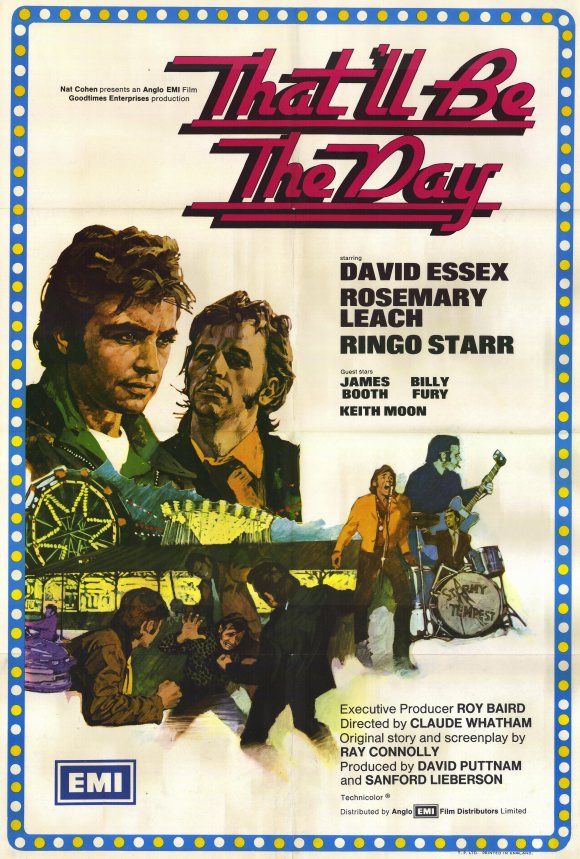
The film that could have been a turning point was That’ll Be the Day (1973), which captured the nostalgia craze in Britain like American Graffiti did here in the States, though it didn’t make much of a splash on American shores. Written by journalist Ray Connolly, it was inspired partly by the story of John Lennon’s rise.  Another influence was Harry Nilsson’s autobiographical song “1941,” about a father abandoning his son, which was one of the first things that drew Lennon to Nilsson, as it mirrored the story of his own childhood.  The movie took place in the late 1950s and featured singer David Essex (“Rock On”) as a young man working at a summer resort.  The streetwise Starr takes him under his wing, and eventually Essex’s character becomes a rock star.

Starr’s role was supporting but large. He played a Teddy boy, English cousins to American greasers, who wore velvet-collared jackets instead of the leather variety.  Starr had been in teddy boy gangs in his youth as a drop out, forced to participate in gang rumbles before finding a way out through music.

Starr brought the same naturalistic, low-key charm to the role he had brought to A Hard Day’s Night. After the flops of his first two genre albums, Starr focussed on films and finally made an undeniably good movie. Had he continued performing in well-written indie films, he could’ve really made it as an actor. But just then, his record career kicked back in with the smash solo album Ringo, produced by Ringo’s best pal Nilsson’s producer Richard Perry.

A sequel was made to That’ll Be the Day called Stardust, in which Essex’ and Starr’s characters go through the decadent, psychedelic sixties. Perhaps because he was enjoying a streak of hit singles, Starr demurred and let buddy Keith Moon replace him in the role.

Starr and Nilsson attempted to do their own horror spoof called Son of Dracula (1974) but it was reportedly so bad Starr could subsequently not bear to look at it.  He also appeared as the Pope in Ken Russell’s follow up to Tommy, Lisztomania (1975), with Roger Daltrey as classical composer Franz Liszt.  But after That’ll be The Day, Starr’s most notable film was, alas, 1981’s goofy comedy Caveman.  He also appeared in McCartney’s meandering Give My Regards to Broad Street, which offered to pleasure of seeing half the Beatles hanging together and playing good music, but little by way of story.

After a string of albums throughout the ‘70s and early ‘80s, Starr’s declining sales brought his recording career to a halt.  Starr’s Old Wave (1983), produced by ex-Eagle Joe Walsh, contained some great tunes, but no label was interested in putting the record out in the U.S. or U.K. It would be his last album for nine years.  For the rest of the decade he only appeared in the aforementioned Broad Street, Little Steven’s Artists United Against Apartheid’s “Sun City” (with his son Zak Starkey), and a Grammy-nominated cover of “Act Naturally” with Buck Owens.

Giving up on finding a new record label, in 1984 he took the Thomas the Tank Engine and Friends narration gig.  Based on a series of children’s books, the TV show became a success in the U.K. and then around the world.  Starr narrated two seasons, and when it spun off an American PBS series called Shining Time Station he played Mr. Conductor, for which he was nominated for a Daytime Emmy in 1989.   “John had the intellectuals; Paul had the teenies and George the mystics; I always got the mothers and babies,” he quipped.   It was nice timing in that he was the first Beatle to become a grandfather, when Zak had a daughter named Tatia Jayne Starkey in 1985.

In 1989 he would form the Ringo Starr All-Star Band, resume touring, and go on to make some of his finest albums.  Still, one wonders what he could have done had he taken on more roles like That’ll Be the Day.

The Road to All Things Must Pass

April 26, 2015 · by solobeatles

The triple album All Things Must Pass was the culmination of a remarkable recipe of influences George Harrison had been synthesizing for years — Indian music, gospel and soul, slide guitar — matched with a new found commitment to more accessible vocals and hit songwriting, all set against producer Phil Spector’s epic backdrop.

In the mid-‘60s Harrison took time out from the guitar and focused on the sitar while Clapton, Hendrix, Beck, Page and others competed to be the most technically impressive. As Simon Leng points out in his excellent book While My Guitar Gently Weeps: The Music of George Harrison, Harrison had been the bridge between ‘50s rock guitarists like Carl Perkins and Elvis’ Scotty Moore and the ‘60s guitar virtuosos, but he didn’t relate to his contemporaries’ showboating.

Then, in late 1968, he visited with Dylan and the Band during the latter’s recording of Music For Big Pink (with tunes such as “The Weight”), and found kindred spirits ushering in a new, more restrained era where the musicians once again served the song itself as opposed to using it as a backdrop for instrumental pyrotechnics.

Dylan and the Band respected Harrison as an equal, so when Harrison returned to London for the January 1969 Get Back sessions, he could no longer endure the condescending treatment he received from Lennon and McCartney, who viewed him as their little brother. He briefly quit, then recalled how much better the guys had behaved when Eric Clapton came into the studio to play on “While My Guitar Gently Weeps” the year before. He hit upon the idea of bringing his friend keyboardist Billy Preston to flesh out the group’s sound, since the climax of the Get Back sessions was going to be a concert on the roof of Apple Records. With Preston in tow, Harrison returned to the group.

Later that year he would produce an album for Preston and also one for Doris Troy (whose hits included “Just One Look”), both soul albums with heavy gospel influence. Working with the Edwin Hawkin Singers gospel choir (whose songs included the classic hit “Oh Happy Day”), he found the black American equivalent of the spirituality he felt in Indian music.  During this time Preston recorded Harrison’s song “My Sweet Lord,” but it went unnoticed.

Harrison then saw first hand how black music could be translated by Southern whites when he met husband-and-wife team Delaney and Bonnie Bramlett, who mixed soul, gospel, rock, blues, and country in a traveling revue called Delaney & Bonnie and Friends. The friends included no less than Clapton, Duane Allman, Leon Russell, Rita Coolidge, Dave Mason, King Curtis, and the guy who would go on to drum with the solo Beatles more than anybody, Jim Keltner. The revue was also how other future regulars Bobby Keys, Jim Price, and Jim Gordon came into the solo Beatles’ orbit. When Harrison saw Delaney and Bonnie in concert on December 1, 1969, he yearned for the entourages’ carefree camaraderie and asked if he could join their tour.

On the road, Harrison asked Delaney how to write gospel songs, and their improvised jam session became the genesis for “My Sweet Lord.” Delaney also mentored Harrison in the slide guitar. Harrison unveiled his new bottleneck technique in an early take of “If Not For You” on Dylan’s album New Morning (1971). Dylan ultimately did not use that take, but Harrison would do his own version of the song on All Things Must Pass (and could be heard on New Morning’s “Day of the Locust.”)

Harrison’s new guitar style, coming as it did at the dawn of his new era as solo artist, was like a superhero giving himself a new costume. He incorporated techniques learned from his apprenticeship in Indian instruments and fused them with slide techniques developed under Delaney’s tutelage, emerging with one of the most distinctive sounds of the early ‘70s, heard on his own songs, Lennon’s, Starr’s, and Beatle protégée Badfinger’s. It was similar to the way Keith Richards crystallized his own unique sound in the late ‘60s with the secret recipe of open tunings and no sixth string.

Along the way Harrison had also transformed his songwriting. When he had stalked out of the Get Back sessions, his songs were not the kind to burn up the hit parade (“For You Blue,” ”Old Brown Shoe,” and “I, Me, Mine”).  But if he was going to tell McCartney and Ono to shove it and still keep his forty-acre estate, he’d have to start writing hits.  Amazingly, he knocked two out of the park: “Here Comes the Sun” and “Something.” The latter became Harrison’s first number one hit and Sinatra proclaimed it the greatest love song of the twentieth century.  Harrison had penned the highlights of the last Beatle album just before the group disintegrated, the ultimate graduation from the Lennon-McCartney songwriting school of osmosis.

Harrison worked on his voice, too. Whereas he once sung with the surliest, thickest Liverpool accent of the bunch, now he lightened it up a notch, as he did with his melodies, fashioning them more warm and upbeat. As with his songwriting, he drew on what he learned vocally from the others, having been the “invisible voice” in the harmonies for ten years.

The Beatles’ producer George Martin never saw Harrison as an equal to Lennon and McCartney, so when Harrison branched out on his own he sought a new partner.  Phil Spector was the maestro behind a string of classic girl group and Righteous Brothers singles in the early 1960s that– in Lennon’s words – kept rock alive between the time Elvis went into the army and the year the Beatles arrived. A tiny man with a Napoleon complex, Spector created  “little symphonies for the kids” via huge orchestras and innovative recording techniques.

Lennon and McCartney both released debut solo albums that were as minimalist as possible – Lennon’s featured just him, Ringo, and Klaus Voormann on bass, while McCartney played everything on his himself.  Harrison, in contrast, brought in Delaney and Bonnie’s sizable backing group and a dozen other musicians.  Harrison was determined not to be like McCartney had been to him and dictate how his friends should play — instead, Harrison allowed the musicians to contribute what they wanted. They would all remember the happy atmosphere of All Things Must Pass.

The explosive bombast of Spector’s production made the album stand out from his ex-bandmates, just as his Indian epics stood apart from the others on the mid-60s Beatles albums. The Spector Wall of Sound was the perfect backdrop for a musician who had been ignored and was now determined to make as big a splash as possible. (Though Harrison would later regret using so much echo.)  Harrison’s euphoria at his freedom was palpable in each cut, and the timing for his religious theme was impeccable.

The end of the ‘60s saw a huge spiritual revival, as people looked for answers in the midst of a massive social upheaval (civil rights movement, anti-war movement, feminist movement, gay rights movement, Sexual Revolution, drug revolution). While many explored Eastern religions, Christianity also saw a huge resurgence, Lennon’s comment that it would “shrink and vanish” notwithstanding. “Jesus Freaks” bridged the gap between hippies and Christians, and the airwaves swelled with Biblical imagery. Songs with Gospel themes included The Byrds’ “Jesus Is Just All Right,” the Youngblood’s “Get Together,” Norman Greenbaum’s “Spirit in the Sky,” Simon and Garfunkel’s “Bridge Over Troubled Water,” and Ocean’s “Put Your Hand in the Hand.” Harrison rode the wave higher than any of them with “My Sweet Lord,” the best selling record of 1971. After its release, two smash hit musicals in a similar vein would open in New York, Jesus Christ Superstar and Godspell.

All Things Must Pass was three discs of much-needed light that countered the depressed darkness of the other Beatles’ debuts, and was the most sprawling high-profile release until Guns N Roses’ Use Your Illusion quadruple album 20 years later.  Harrison referred to the set as recovering from an “an eight-year dose of constipation,” an appropriate description for the first triple album by a mainstream artist. Many of the songs had been composed over the previous four years but rejected by Lennon and McCartney for inclusion on Beatles albums. In 1966 Harrison got three songs on Revolver (his peak in per-album composition count), but “Art of Dying” and “Isn’t It a Pity” were rejected. It was at this time that Harrison started stockpiling tunes, though many of the most accessible tunes on All Things Must Pass seem to have been composed after Harrison had his “Something”/”Here Comes the Sun” commercial breakthrough: “My Sweet Lord,” “What Is Life,” “Awaiting on You All,” and “The Ballad of Frankie Crisp.”

As George Martin said about The White Album, it would have been advisable for Harrison to carve All Things Must Pass down to one stupendous release and dole out the best of the rest over the next year or two. As it was, his next studio release wouldn’t come until 1973. With the third album comprised of long studio jams with Eric Clapton and friends, Harrison did seem to be pushing the limits of what a Beatle could get away with. Yet despite a hefty price tag, the album sat at No. 1 for seven weeks in the US and eight in the UK.

It would take Harrison 18 years to come close to revisiting that level of success. In 1970 and 1971, however, it seemed that the younger brother had left his older siblings in the dust.

Had Harrison pared it down to one stellar record, it could have been an undisputed masterpiece. And the two primary moods of the album could each rest nicely on either side of the album: the epic Spector orchestrations on side one, with the country/folk sound influenced by Dylan, the Band, and Nashville guitar player Pete Drake on side two.

Side One

  1. My Sweet Lord
  2. What Is Life
  3. Awaiting on You All
  4. Wah-Wah
  5. Hear Me Lord
  6. Run of the Mill
  7. Isn’t It A Pity

Side Two

  1. I’d Have You Anytime (co-written by Dylan)
  2. If Not For You (Dylan)
  3. Behind That Locked Door
  4. I Live For You (belatedly released on the 2000 remastered version)
  5. Apple Scruffs
  6. Ballad of Sir Frankie Crisp
  7. All Things Must Pass

Lennon’s Only Non-Album B-Side: “Move Over Ms. L”

April 18, 2015 · by solobeatles

I didn’t cover this song in my book but here’s an article on it from the fantastic website www.beatlesbible.com:

The b-side to John Lennon’s Stand By Me single was first recorded during the sessions for the Walls And Bridges album.

Move Over Ms L was originally intended to appear on Walls And Bridges, but was left off at the last minute. It had been positioned between Surprise Surprise (Sweet Bird Of Paradox and What You Got on the album’s second side, but Lennon decided to remove it just before the pressing was due to begin, fewer than three weeks before its release.

Move Over Ms L was later re-recorded, and subsequently became the only non-album b-side of Lennon’s career, and was issued with the Stand By Me single, taken from the Rock ‘N’ Roll album, in early 1975.

The song vaguely poked fun at Lennon’s estranged wife Yoko Ono, although the playful lyrics were clearly not intended to hurt the woman who once referred to herself in song as Mrs Lennon.

Now to err is something human and forgiving so divine
I’ll forgive your trespasses if you forgive me mine
Life’s a deal, you knew it when you signed the dotted line
They nail you to the paper, put a rope around your neck
And so we sing along, the boy stood on the burning deck

Lennon recorded a home demo of Move Over Ms L prior to recording Walls And Bridges. He performed the song on an electric guitar, playing a boogie riff and singing the chorus in falsetto while his girlfriend May Pang made a phone call in the background.

A second demo was taped around a month later, in June 1974. A more serious attempt than the first, this was performed on an acoustic guitar. Lennon whispered the lyrics in an apparent attempt to not wake up Pang, and featured a quick improvised impression of Ono.

Lennon finally brought the song to the studio during the Walls And Bridges sessions. It was recorded in just three takes on 15 July 1974; one of the attempts was released on the 1998 box set John Lennon Anthology. This was more country and western in its feel, with a slide guitar solo by Jesse Ed Davis, but evidently failed to capture the sound Lennon was after.

The song was then given to Keith Moon, one of Lennon’s drinking buddies during the Lost Weekend. Moon recorded the song for his album Two Sides Of The Moon, and was released in April 1975. It was also the b-side of his single Solid Gold.

Lennon re-recorded Move Over Ms L in October 1974, and it became the only original composition of the Rock ‘N’ Roll sessions. This time Lennon was satisfied with the recording, and it was duly issued with the Stand By Me single.

Written by: Lennon
Recorded: 15 July 1974; 21-25 October 1974
Producer: John Lennon

Released: 18 April 1975 (UK), 10 March 1975 (US)

John Lennon: vocals, electric guitar
Jesse Ed Davis: electric guitar
Eddie Mottau: acoustic guitar
Klaus Voormann: bass guitar
Ken Ascher: piano
Bobby Keys, Steve Madaio, Howard Johnson, Ron Aprea, Frank Vicari: horns
Jim Keltner: drums
Arthur Jenkins: percussion

Available on:
John Lennon Signature Box
John Lennon Anthology

Ultimate Yacht Rock: McCartney’s “Girls’ School”

April 17, 2015 · by solobeatles

Wings’ rhythm guitarist Denny Laine lived on a houseboat, so he suggested making their next album (which would end up being called LONDON TOWN) on the water. So in May 1978, the group set up shop on the yacht Fair Carol in the Virgin Islands.

The band established a routine of a three- or four-hour session in the morning, followed by water skiing, swimming, and eating lunch cooked by the captain/chef. When they played, dolphins would swim around the boat digging the sound.

The song came about when McCartney was in Hawaii reading the back of the newspaper where they had the ads for the porno flicks. McCartney wrote down the titles—School Mistress, Curly Haired, Kid Sister, The Woman Trainer—and made up a song based on them. It was another creation in the Beatles tradition of “found art,” like when Lennon lifted all the words for “Being for the Benefit of Mr. Kite” from a vintage poster.

Lead guitarist Jimmy McCulloch loved rocking out in concert and was generally frustrated by the low-key songs of LONDON TOWN, but here he had a perfect vehicle to let it rip with Laine.

As was McCartney’s wont, he held prime cut “Girls’ School” off the album to serve as the rocking B-side to the softer A-side (in this case, “Mull of Kintyre”), a tradition going back to “Another Day”/“Oh Woman Oh Why.” Like that earlier B-side, this one sports a riff that seems strangely reminiscent of a tune on the album LED ZEPPELIN III, in this case, a simplified “Celebration Day.”

In the United Kingdom, the A-side “Mull” became the biggest non-charity single of all time, yet it flopped mysteriously in the United States. “Girls’ School” did better in the States, reaching number thirty-three. It would’ve been a great video to see them on the yacht rocking this one out to the dolphins.

“Café on the Left Bank” is another propulsive mid-tempo rocker from the sessions. The lyrics and McCulloch’s guitar work carry some of the cosmopolitan glamor of Duran Duran’s “Rio” and “Hungry Like the Wolf” four years early. It’s a travelogue sketch of hanging amidst Parisian crowds, dancing in the nightclubs, staggering back to your car and eating breakfast in the bars.

McCartney wanted to see what it would be like to record while the yacht was actually moving, which would have been a very Duran Duran moment, but unfortunately the motion flung Joe English into his drums and the concept was quickly abandoned.


The McCartney/Costello Demos

March 27, 2015 · by solobeatles

The mid-‘80s saw a dip in McCartney’s career after the triumph of his 1982 album Tug of War.  Pipes of Peace (1983) received lukewarm critical response, his feature Give My Regards to Broad Street (1984) was a box office flop, and Press (1986) saw a significant drop in sales compared to his earlier releases.  McCartney decided an overhaul was in order and reached out to Elvis Costello (born Declan MacManus).

Costello originally rose to fame as a member of the late ‘70s punk/New Wave movement due to his angry intellectual persona, but the sophistication of his snarky wordplay and torch song melodies made him a genre all to himself.  Also, like McCartney he had a musician father, a Liverpudlian mother — and he had joined the Beatles fan club at age 11.

On George Harrison’s recent comeback album Cloud Nine (1987), producer Jeff Lynne cajoled him to get back in touch with the Beatle qualities he had suppressed in order to prove he could make it on his own.  On Flowers in the Dirt, Costello did the same for McCartney, first by encouraging him to get his Hofner violin bass out of mothballs. Deciding the past was now far enough away, McCartney did so and from then on played it regularly.

McCartney relished working with Costello, whose cynical persona was reminiscent of Lennon’s. However, when Costello started answering back in song, as Lennon did in “Getting Better,” McCartney initially balked, fearing they were setting themselves up for too close a comparison.  Still, he eventually relaxed, and Costello joined the tradition of singing partners with whom McCartney competes for a girl in a song. Lennon did so in “You’re Gonna Lose That Girl,” Michael Jackson in “The Girl Is Mine,” and Costello in “You Want Her Too.”

In 1987 and 1988, McCartney and Costello recorded an album’s worth of acoustic demos. Twelve were eventually re-recorded for various albums or b-sides, but to many hardcore fans the demos are actually superior to the slickly produced official versions. The high-pitched harmonies of the “My Brave Face” demo have the strength and purity of the Fabs in 1963.

The “Don’t Be Careless Love” demo recalls the heyday of British duos like Chad and Jeremy and Peter and Gordon, but on Flowers in the Dirt, McCartney dropped Costello’s voice in the mix and swathed it with ‘80s production gauze.

He did the same for “That Day Is Done,” but at the Concert for Linda’s Memorial in 1999, Costello knocked it out of the park accompanied just by piano.

Hopefully, Macca and Costello will officially release the original demos one day soon.

Probably their finest collaboration was “Veronica,” which appeared on Costello’s 1989 album Spike. A shimmering up-tempo number, paradoxically it was about Costello’s grandmother who suffered from Alzheimer’s.  (“The Day is Done” was about her death.)  It was Costello’s biggest hit in the US, making it to No. 19 on Billboard and No. 1 on the Modern Rock chart.

Of the twelve McCartney-Costello songs that have so far seen official release, the only ones on which the two sing together are “My Brave Face,” “You Want Her Too,” and “Veronica.” The others include: the fine “Back on My Feet,” b-side to McCartney’s “Once Upon a Long Ago” (on bonus reissues of Flowers in the Dirt), “Don’t Be Careless Love” and “That Day Is Done” on Flowers in the Dirt, “Mistress and Maid” and “The Lovers That Never Were” on McCartney’s Off the Ground (1993), “Pads, Paws, and Claws” on Costello’s Spike (1989), “So Like Candy” and “Playboy to a Man” on Costello’s Mighty Like a Rose (1991), and “Shallow Grave” on Costello’s All This Useless Beauty (1996).

Vince Guaraldi and Marianne Faithfull cover “I’m a Loser”

March 25, 2015 · by solobeatles

Two interesting takes on Lennon’s 1964 classic. Guaraldi of course did the music for the Peanuts TV Specials, starring the world’s biggest loser, Charlie Brown, so this was a natural cover.

Solo Beatles discussion with Larry Rifkin Of WATR’s “Talk Of The Town”

March 2, 2015 · by solobeatles

Larry was kind enough to have me on last week to talk about the music of John, Paul, George, and Ringo after 1970. You can hear the conversation here. Thanks, Larry!

http://www.rifkinradio.com/?p=303

McCartney Gets “Back on His Feet” with the Help of Elvis Costello

February 23, 2015 · by solobeatles

In the mid-’80s, the commercial drop off that had hit Starr and Harrison finally caught up to McCartney. First, his feature film GIVE MY REGARDS TO BROAD STREET (1984) was not well-received by the critics. For his follow up, 1986’s PRESS TO PLAY, he enlisted cutting edge producer Hugh Padgham (the Police, Phil Collins, Genesis, Peter Gabriel), but the record failed to go gold and was his worst-selling album to date.

As workaholic as ever, McCartney immediately started the next record with Billy Joel’s band and producer Phil Ramone, and they created an early version of “Back on My Feet.”

Ramone was dead center in the mainstream, but to spruce up the lyrics McCartney turned to New Wave singer-songwriter Elvis Costello. In their first meeting, they both brought unfinished songs for the other to fill in, like McCartney did with Lennon in the old days. Costello immediately helped bring “Back on My Feet” into sharp focus with concrete, vivid details.

In the first two verses, the protagonist is an old man railing at the thunderstorm pouring down on him, vowing to bounce back in the face of bruising setbacks. The defiance turns into cheerful optimism in the final verse, as a resilient young girl becomes the new protagonist, yelling that she’ll be back on her feet to the passing traffic. The characters ask us for a hand but warn us not to pity them, as they’ve seen things we’ll never see.

McCartney was still in a movie mindset and sings that the song is “in CinemaScope.” Each verse begins with cinematic terminology: “Reveal a,” “Cut to the,” “Focus in on,” “Cut back again to a . . .” At the end, McCartney sings that the song fades out as he pulls down the shade.

The amazing thing about McCartney is the number of times he’s rebounded from flops that would have discouraged someone with less fortitude: MAGICAL MYSTERY TOUR, WILD LIFE, BROAD STREET, Heather Mills. Perhaps the cost of producing so many successes was the inevitable dud, but the guy was a machine who never stopped.

“Back on My Feet” became a B-side that marked a moment of resurgence. The non album A-side “Once upon a Long Ago” featured an impressive orchestral lushness but also sappy lyrics about puppy dog tails, blowing balloons, and children searching for treasure, not to mention a Kenny G–like sax solo perfect for the corporate luncheon crowd. Costello arrived just in time to remind McCartney how not to be corny.

To Musician, Costello said, “There’s no denying that [McCartney] has a way of sort of defending himself by being charming and smiling and thumbs up and all the bit. I said once that I thought he should try and step from behind that, at least insofar as the music was concerned.”

Re-energized and refocused, with his next album (FLOWERS IN THE DIRT) and subsequent world tour, McCartney would indeed be back on his feet.

“Move Over Busker” was another fun track from the period that shared the movie imagery of “Back on My Feet,” along with its resolve to overcome the disappointment of GIVE MY REGARDS TO BROAD STREET.

A pub rocker refitted with a modern sound, “Move Over Busker” was akin to a surreal Bob Dylan tune in the sense that McCartney meets a famous actor from the past in each of the three verses.

The first is Nell Gwynne, an actress and mistress of King Charles II in the 1600s. She started out selling oranges in the theater as cover for the fact that her real job was to be a liaison between the male patrons and the actresses backstage, who were also prostitutes. Hence, McCartney sings to her that he’ll have one of her oranges, but she tells him to “Move Over Busker.”

In the next verse he sees Mae West. Quoting her famous catch phrase, McCartney tells her he’ll come up and see her sometime, but she tells him to “Move Over Busker.”

It’s as if, in McCartney’s subconscious, after BROAD STREET’S failure he keeps getting rejected by actresses and is reduced to playing for change in the street.

Finally, in the bridge, he beats his chest and asserts that no one can hold him back and his time will come again. We see both the desperation and steely drive that kept him working for the chart hits. He sings that he wants to stay with the action, knowing if he doesn’t “grab it now,” his “great illusion” will vanish, before busting out with a Little Richard howl.

In the third verse, he’s nursing his injured pride when he sees a satisfied Errol Flynn being called into his trailer by a lusty lady. Flynn’s getting the love now, but McCartney tells him to move over, busker, because Flynn’s day is done and McCartney’s is on the way.

In the tradition of his ’70s albums, the refrain “good times coming” echoes another song on PRESS TO PLAY, “Good Times Coming/Feel the Sun.”

Page 5 of 12 « Previous 1 … 3 4 5 6 7 … 12 Next »
  • Create a free website or blog at WordPress.com.
Privacy & Cookies: This site uses cookies. By continuing to use this website, you agree to their use.
To find out more, including how to control cookies, see here: Cookie Policy
  • Subscribe Subscribed
    • solobeatles
    • Already have a WordPress.com account? Log in now.
    • solobeatles
    • Subscribe Subscribed
    • Sign up
    • Log in
    • Report this content
    • View site in Reader
    • Manage subscriptions
    • Collapse this bar
 

Loading Comments...