You might have thought the animators for the Beatles’ Saturday morning cartoon would have been at a loss for how to build an episode around Lennon’s lysergic ode to The Tibetan Book of the Dead, but you’d be wrong …
Archive For May, 2015
They Should’ve Done This Instead of Magical Mystery Tour
In 1967, the Beatles discussed starring in LORD OF THE RINGS. John wanted to play Gollum, mystic George was going to be Gandalf, Paul would be Frodo and Ringo would be Sam. To direct it, John contacted Stanley Kubrick (A Clockwork Orange, Dr. Strangelove, 2001). Tolkien himself nixed the idea, since he controlled the film rights, but it is fun to imagine what the film would have been like. The Beatles were notoriously impatient during film shoots, so doing a film with the slow-moving, meticulous Kubrick would have been one of the most fantastic films of the decade or a totally insane train wreck.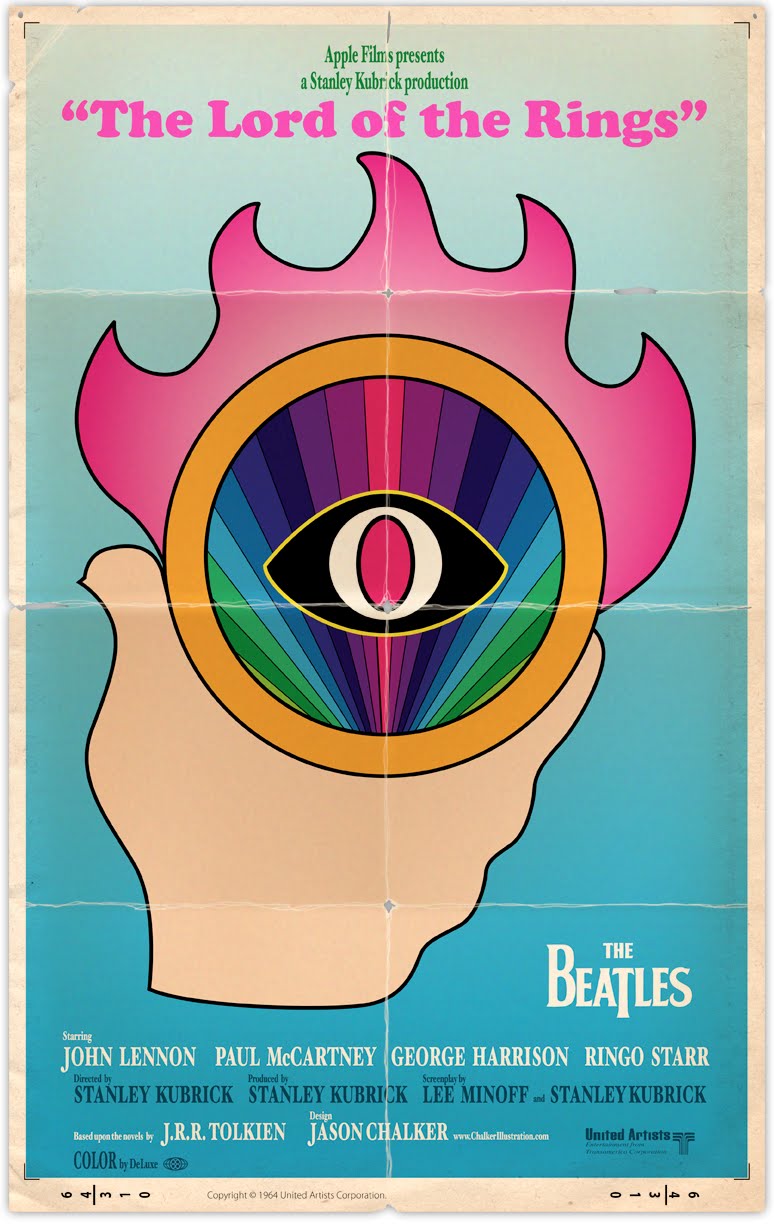
George’s Original Version of “It Don’t Come Easy”
Harrison had a habit of offering his best tunes to his friends. He originally gave “My Sweet Lord” to Billy Preston. He gave a song called “You Gotta Pay Your Dues” to Badfinger, although they turned it down.
So Starr took a crack at “You Gotta Pay Your Dues” during his Sentimental Journey sessions. George Martin produced and Stephen Stills was on the piano, but after thirty takes on February 18 and 19, 1970, it still wasn’t coming easy.
Thus Harrison sang a demo himself with Badfinger on backing vocals, instructing them to chant “Hare Krishna!” during the instrumental. In the final version of the song you can still hear it, low in the mix.
Starr tackled the song again on March 8, this time with Harrison producing. It sat in the can until October, at which point Harrison added sax and trumpet like he had once added horns to The White Album’s “Savoy Truffle.”
In mid-April 1971, Harrison’s haunting guitar intro finally drifted across the airwaves. Its arresting sound came courtesy of the Leslie speaker cabinet.
The cabinet was originally built for the Hammond organ but had been adapted for guitar and vocals. It housed a rotating bass speaker and a pair of horn speakers that spun around in different directions, making the guitar sound as if it was swirling under the ocean. Lennon ran his vocals through the Leslie for 1966’s “Tomorrow Never Knows,” and Harrison had used it in 1969 when he wrote “Badge” with Clapton for Cream; in fact, the “Badge” instrumental break sounds pretty close to “It Don’t Come Easy.” Harrison was always a master at recycling—or should we say, developing further. Thus the outro of “A Hard Day’s Night” became the intro to “Ticket to Ride.”
The Leslie effect became one of the most distinctive sounds of the late ’60s and early ’70s, gracing songs including Harrison’s “Something,” Badfinger’s “No Matter What,” the Grateful Dead’s “Casey Jones,” Three Dog Night’s “Mama Told Me Not to Come,” The Hollies’ “Air That I Breathe,” the Eagles’ “Hotel California,” Boston’s “More Than a Feeling,” and even McCartney’s “Listen To What the Man Said.”
Badfinger’s soaring backing vocals, Stills’s pounding piano, Starr’s perfect drum fills, and the horns build an epic momentum behind Starr’s exhortation to stay resilient in the face of hardship. The lines about paying dues to pay the blues probably wouldn’t have worked with Harrison singing; the guy came from a stable family and was a superstar before he was twenty. But Starr was born into an inner city house without a toilet, fell into a coma from appendicitis at age six, then was confined to a sanatorium for two years at age thirteen due to tuberculosis, before dropping out of school altogether.
In Beatles tradition, the lyrics challenged the listener to be peaceful. It was a sentiment that could apply on any scale, though it might have been aimed at McCartney, who was taking the others to court at the time. Yet with a reunion increasingly unlikely, the song actualized Harrison’s and Starr’s determination to carve out a career for themselves independent of the Lennon and McCartney gravy train.
Starr preaches with such confidence that you wouldn’t know he was filled with doubt about the direction of his life. Perhaps his determination to transcend his fears is what fills the performance with its enduring power.
Forty years later, Starr still opens every show with it. The song shot up the charts, passing Lennon’s “Power to the People,” Harrison’s “What Is Life” (both reached number eleven), and McCartney’s “Another Day” (number five), all the way up to number four, settling just beneath the Rolling Stones’ “Brown Sugar” at number one. It was the first of three top ten hits Harrison cowrote or produced for Starr. The success stunned those who had assumed Starr couldn’t cut it on his own.
(Compare “Badge” at 1:09 to “It Don’t Come Easy” intro)
(There it is again in “You Never Give Me Your Money” at 3:37)
Macca Gets Freaky With “Monkberry Moon Delight”
Backed by what sounds like a villainous circus organ from a creepy 1930s cartoon, McCartney lurches in with a voice that has gone beyond Little Richard into demented Screamin’ Jay Hawkins territory. In Hawkins’s seminal hit “I Put a Spell on You” (1956), he shrieked, gargled, cackled, and guffawed like an unhinged black Vincent Price. Onstage he would rise from a coffin bearing voodoo props. Later, Tom Waits would take up his growling, guttural mantle.
In his incendiary 1970 Rolling Stone interview, Lennon expressed surprise at McCartney’s self-titled first solo album, saying he expected more from him. At the dawn of 1971, McCartney found himself in the position of being dismissed by the critics while Lennon and Harrison were heaped with praise for their LPs Plastic Ono Band and All Things Must Pass. Pelted with tomatoes in his mind, he realized he must catch up with his second album Ram or be left behind.
He goes to the piano in the attic while the wild wind howls. He’s getting older, his hair’s a mess, he’s in his pajamas, his stomach is in knots from the bad reviews, and the rats are in the walls (both real farm rats and the ex-bandmates in his mind).
But then he sees Linda giving the kids their milk and it inspires him to get back in touch with his own absurd inner child. “When my kids were young they used to call milk ‘monk’ for whatever reason that kids do—I think it’s magical the way that kids can develop better names for things than the real ones. In fact as a joke, Linda and I still occasionally refer to an object by that child-language name. So, monk was always milk, and monkberry moon delight was a fantasy drink, rather like ‘Love Potion No. 9,’ hence the line in the song ‘sipping monkberry moon delight.’ It was a fantasy milk shake.”
Linda echoes his words like a gum-smacking, seen-it-all, hand-on-her-hip New York moll. Her singing gilds the razor’s edge of flatness with surprising defiance, as coached meticulously by her perfectionist husband. Finally, he degenerates into eerie howling and spastic mumbling.
Hawkins would go on to release “Monkberry Moon Delight” as a single in 1973.
Starr Recaptures the ’60s Sound with ’80s Disciples
A jewel that could have come off of Help! or Rubber Soul, “I Don’t Believe You” was a track on one of Ringo’s best albums, Time Takes Time (1992). It was written by two members of the San Francisco power pop band Jellyfish, Andy Sturmer and Roger Manning, who also added backing vocals and acoustic guitars.
Another guy in Jellyfish, Jason Faulkner, had been in The Three O’clock, which was part of a short-lived Los Angeles movement called The Paisley Underground. That scene was comprised of groups in the ‘80s who were trying to sound like the ’60s in opposition to the synthesizers and drum machines that were then dominating the pop charts. The Bangles were the biggest Paisley Underground group to make it, epitomizing the genre with their 1985 single “Going Down to Liverpool.”
When the Ringed One speak-sings his lines as the backing singers answer him in harmony, the song is a perfect homage to the Beatles circa “You’re Gonna Lose That Girl” or “Run For Your Life” … not to mention Beatle-imitators like the Monkees or Knickerbockers.
Many mid-‘60s garage nuggets (such as Syndicate of Sound’s “Little Girl”) feature an agitated singer warning his woman that he knows she’s done him wrong and he’s at the end of his rope. Starr’s girlfriend has lied to him and maxed out his credit cards to buy fancy clothes and “powder for her nose.” So he’s kissing her goodbye for good, just in time for the rollicking instrumental with cries of “Ole! Ole!”
In the early ‘60s, McCartney wrote a number of these “disillusioned-with-my-woman” tunes, too, including one for Starr called “If You’ve Got Troubles” that went unreleased until being included on volume one of the Beatles Anthology. Oasis must’ve heard it earlier on a bootleg because they pilfered the riff for 1994’s “Up in the Sky.”
Credit for the album’s sound also goes to producer Don Was. Born Don Fagenson in Detroit in 1952, he was one of the founding members of Was (Not Was). The band had hits in the ‘80s, then Was racked up a stunning producer’s resume, doing albums or songs for Bob Dylan, Al Green, Garth Brooks, Iggy Pop, George Clinton, Paul Westerberg, and helping Bonnie Raitt win the 1990 Grammy Album of the Year for Nick of Time. He was also the producer the Stones picked to help them remaster Exile on Main Street in 2010 and find overlooked gems that could be refurbished for the Exile bonus album.
It’s a pity Time Takes Time is the only album Starr did with Was, but Starr continued to mine the ‘60s folk rock sound on his subsequent albums with producer Mark Hudson.
Ringo’s Movie Career
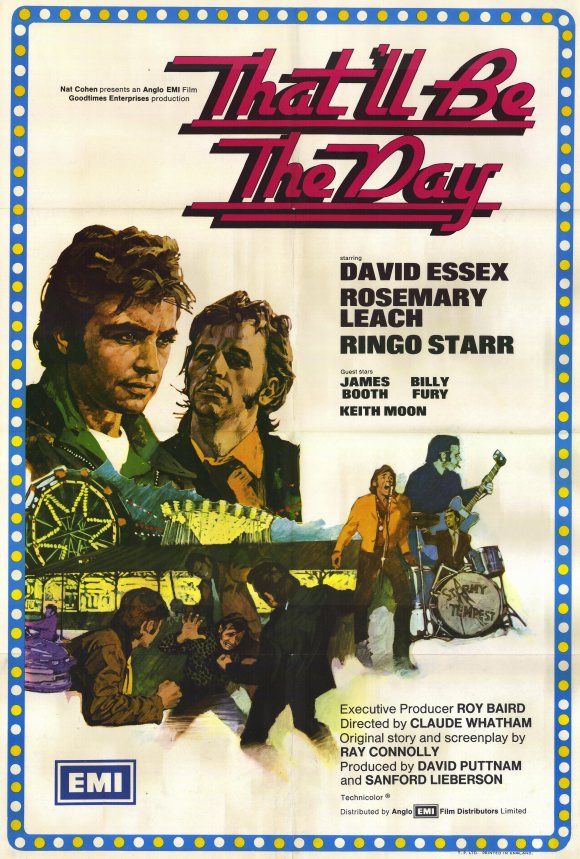
In the early ‘70s Ringo was wondering what he was going to do with the rest of his life. He drummed on Lennon and Harrison’s albums, but that wasn’t enough. He started a furniture company and designed things like donut-shaped fireplaces and flower-shaped tables with petal seats. But mainly, he wanted to be an actor.
Back in ’64 he showed up on the set of A Hard Day’s Night terribly hung over to shoot the part of the movie that featured him alone, and his doleful countenance was praised as pristine naturalism. Thus the Beatles built their next movie, Help!, around Starr. Indeed, while original drummer Pete Best may have been broodingly handsome (too handsome as far as McCartney and Lennon were concerned), Starr’s distinct look and persona were essential to the loveable moptop image that was so easily translated into cartoons and lunchboxes. (Most anything that reaches global proportions has to be able to be translated into cartoons and lunchboxes.)
Lennon was the first Beatle to try his hand at acting in a movie apart from the others (in How I Won the War, which I still have not been able to bring myself to sit through). But in 1968, after briefly quitting during The White Album sessions, Ringo started his own career.
He could’ve used an astute manager to help him select projects, however. Most of Starr’s films stand as cautionary artifacts of late ‘60s drug-addled indulgence. There were two disappointing Terry Southern adaptations – Candy (1968) and The Magic Christian (1969) with Peter Sellers — Frank Zappa’s 200 Motels (1971), an Italian spaghetti Western Blindman (1971), and probably the best of them, Harry Nilsson’s animated TV special The Point! (1971). In 1972, Starr directed a rockumentary about his good friend Marc Bolan of T. Rex called Born to Boogie.
The film that could have been a turning point was That’ll Be the Day (1973), which captured the nostalgia craze in Britain like American Graffiti did here in the States, though it didn’t make much of a splash on American shores. Written by journalist Ray Connolly, it was inspired partly by the story of John Lennon’s rise. Another influence was Harry Nilsson’s autobiographical song “1941,” about a father abandoning his son, which was one of the first things that drew Lennon to Nilsson, as it mirrored the story of his own childhood. The movie took place in the late 1950s and featured singer David Essex (“Rock On”) as a young man working at a summer resort. The streetwise Starr takes him under his wing, and eventually Essex’s character becomes a rock star.
Starr’s role was supporting but large. He played a Teddy boy, English cousins to American greasers, who wore velvet-collared jackets instead of the leather variety. Starr had been in teddy boy gangs in his youth as a drop out, forced to participate in gang rumbles before finding a way out through music.
Starr brought the same naturalistic, low-key charm to the role he had brought to A Hard Day’s Night. After the flops of his first two genre albums, Starr focussed on films and finally made an undeniably good movie. Had he continued performing in well-written indie films, he could’ve really made it as an actor. But just then, his record career kicked back in with the smash solo album Ringo, produced by Ringo’s best pal Nilsson’s producer Richard Perry.
A sequel was made to That’ll Be the Day called Stardust, in which Essex’ and Starr’s characters go through the decadent, psychedelic sixties. Perhaps because he was enjoying a streak of hit singles, Starr demurred and let buddy Keith Moon replace him in the role.
Starr and Nilsson attempted to do their own horror spoof called Son of Dracula (1974) but it was reportedly so bad Starr could subsequently not bear to look at it. He also appeared as the Pope in Ken Russell’s follow up to Tommy, Lisztomania (1975), with Roger Daltrey as classical composer Franz Liszt. But after That’ll be The Day, Starr’s most notable film was, alas, 1981’s goofy comedy Caveman. He also appeared in McCartney’s meandering Give My Regards to Broad Street, which offered to pleasure of seeing half the Beatles hanging together and playing good music, but little by way of story.
After a string of albums throughout the ‘70s and early ‘80s, Starr’s declining sales brought his recording career to a halt. Starr’s Old Wave (1983), produced by ex-Eagle Joe Walsh, contained some great tunes, but no label was interested in putting the record out in the U.S. or U.K. It would be his last album for nine years. For the rest of the decade he only appeared in the aforementioned Broad Street, Little Steven’s Artists United Against Apartheid’s “Sun City” (with his son Zak Starkey), and a Grammy-nominated cover of “Act Naturally” with Buck Owens.
Giving up on finding a new record label, in 1984 he took the Thomas the Tank Engine and Friends narration gig. Based on a series of children’s books, the TV show became a success in the U.K. and then around the world. Starr narrated two seasons, and when it spun off an American PBS series called Shining Time Station he played Mr. Conductor, for which he was nominated for a Daytime Emmy in 1989. “John had the intellectuals; Paul had the teenies and George the mystics; I always got the mothers and babies,” he quipped. It was nice timing in that he was the first Beatle to become a grandfather, when Zak had a daughter named Tatia Jayne Starkey in 1985.
In 1989 he would form the Ringo Starr All-Star Band, resume touring, and go on to make some of his finest albums. Still, one wonders what he could have done had he taken on more roles like That’ll Be the Day.
 solobeatles